How Scientists Measure the Age of Fossils (Dating Methods)
In 1953, a geochemist named Clair Patterson announced that the Earth was 4.55 billion years old — a number so precise, derived from rocks so unassuming, that it rewrote humanity’s sense of its own antiquity. He got it from meteorites and ancient lead ores, using a clock built into the atoms themselves. Every fossil ever dated — every dinosaur bone, every trilobite, every hominin skull — is dated by the same fundamental trick: nature’s radioactive clocks, ticking away inside rocks since before there was life to fossilize.
How do scientists measure the age of fossils? Not with one method but a toolkit of them, each suited to different timescales, cross-checking each other like witnesses. Here’s how the clocks work.
Radiometric Dating: The Atomic Clock
The foundation is radioactive decay. Certain atoms (isotopes) are unstable and decay into different elements at a perfectly constant rate, measured by the half-life — the time for half the atoms to decay. Uranium-238 decays to lead-206 with a half-life of 4.47 billion years; potassium-40 decays to argon-40 with a 1.25-billion-year half-life; carbon-14 decays to nitrogen-14 with a 5,730-year half-life. These rates are immune to heat, pressure, chemistry — anything short of nuclear physics. They’re the most reliable clocks in nature.
The method: measure the ratio of parent isotope to daughter product in a sample. A rock with equal parts uranium-238 and lead-206 has been ticking for one half-life — 4.47 billion years. It’s elegantly simple in principle and fiendishly precise in practice, requiring mass spectrometers that count atoms. The U.S. Geological Survey’s geochronology research maintains these techniques as the gold standard for deep-time dating.
The Catch: You Can’t Date the Fossil Itself
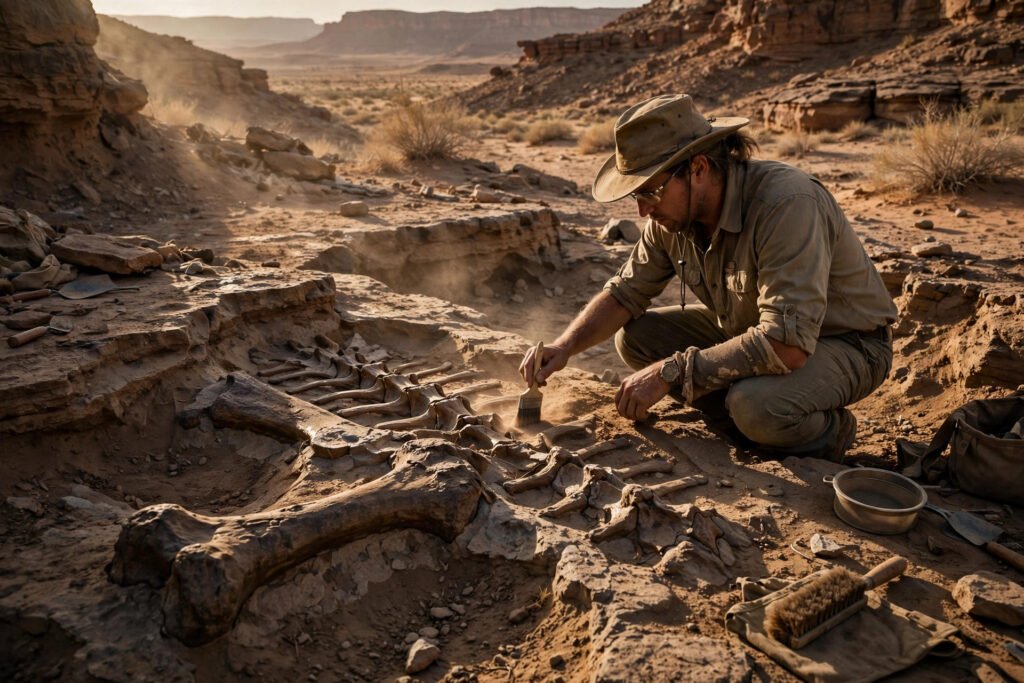
Here’s the twist most people miss: radiometric dating usually doesn’t date the fossil — it dates the rocks around it. Fossils are typically too young in their chemistry (bone mineral exchanges atoms with groundwater) and too poor in the right isotopes. Instead, geologists date volcanic ash layers or lava flows above and below the fossil bed. A fossil sandwiched between a 70-million-year-old ash layer and a 68-million-year-old one is 68–70 million years old. The fossil gets its age from its geological neighbors.
This is why volcanic regions are paleontological gold mines: East Africa’s Rift Valley, where many hominin fossils are found, is layered with datable ash from ancient eruptions. A fossil in ash-free sandstone — common in North America — is much harder to pin down precisely, and its age may be estimated from the rock formation’s known span rather than a direct date.
Carbon-14: The Young-Fossil Specialist
For fossils younger than ~50,000 years, carbon-14 is the star. Living things absorb carbon-14 from the atmosphere while alive; when they die, absorption stops and the clock starts ticking with its 5,730-year half-life. Measure the remaining carbon-14, and you know time since death. It’s how we date Ötzi the Iceman, Egyptian mummies, and the last mammoths.
Carbon dating has famous complications: atmospheric carbon-14 levels varied over time (calibrated using tree rings), marine organisms absorb “old” carbon from the ocean (the marine reservoir effect), and anything after 1950 is contaminated by atomic-bomb carbon-14 — which, perversely, makes bomb-era carbon a precise dating tool for modern forensic work. Beyond ~50,000 years, too little carbon-14 remains to measure, and older methods take over.
Relative Dating: The Logic Before the Clocks
Before radiometric dating existed, geologists ordered fossils by pure logic — and the logic still underpins everything. The principle of superposition: in undisturbed rock layers, deeper is older. Index fossils: certain species lived for short, known spans worldwide, so finding one dates the rock (trilobite species are the classic example). Cross-cutting relationships: a fault or intrusion cutting through layers is younger than what it cuts.
These relative methods built the entire geologic time scale — Jurassic, Cretaceous, and all the rest — before a single absolute date existed. Radiometric dating later hung numbers on the framework, and the two systems check each other constantly. When they agree (as they overwhelmingly do), confidence is very high. The Smithsonian’s paleontology collections showcase how these methods combine to date iconic specimens.
How Precise Can It Get?
Modern uranium-lead dating of volcanic ash can achieve precision better than 0.1% — dating a 66-million-year-old layer (the dinosaur-killing boundary) to within tens of thousands of years. That’s like measuring a football field’s length to within an inch. Multiple methods applied to the same fossil bed should converge; when they don’t, geologists investigate rather than average — discordance usually reveals something interesting, like reheating or contamination, not failure of the method.
The creationist objection — “were you there?” — misunderstands how science validates clocks. Radiometric methods are tested against objects of known age (recent lava flows, historically dated artifacts) and against each other (different isotope systems on the same rock must agree). They pass these tests routinely. The clocks are checked; they keep excellent time.
Dating the past is ultimately about preserving it, too — which starts with knowing what old things are worth keeping. The same careful assessment applies at home: what to do with old photo albums is the household version of archival science. And judging age and value in the wild — telling if a thrift-store find is good quality — uses the same observational muscles paleontologists use on fossils.
Beyond Rocks: Dating Without Radioactivity
Not every clock is atomic. Dendrochronology — tree-ring dating — counts annual growth rings to date wooden artifacts to the exact year, and its master chronologies stretch back 14,000 years. Varve counting reads annual sediment layers in lake beds like pages. Amino acid racemization measures the slow conversion of amino acids in shells and bones. Each method has its niche, and the strongest dates come from convergence: when tree rings, carbon-14, and stratigraphy all agree, the age is as solid as science gets.
Conclusion
Scientists measure the age of fossils with radiometric clocks — uranium-lead and potassium-argon for deep time, carbon-14 for the last 50,000 years — usually by dating the volcanic rock layers bracketing the fossil rather than the fossil itself, all cross-checked against relative methods like superposition and index fossils. It’s a system of independent witnesses that agree with each other to extraordinary precision. When a museum label says “68 million years old,” that’s not a guess. It’s an atomic measurement.
Frequently Asked Questions
Can scientists date a fossil directly?
Rarely. Most fossils lack the right isotopes in measurable amounts, so geologists date volcanic layers above and below the fossil bed instead. Carbon-14 can directly date young organic fossils (under ~50,000 years).
How accurate is carbon dating?
Very, within its range — typically within decades to centuries for recent samples, after calibration with tree rings. Its limits are the 50,000-year range and complications like the marine reservoir effect.
What is the oldest fossil ever dated?
Stromatolites (layered bacterial mats) in Greenland date to ~3.7 billion years; disputed microfossils may reach 4.2 billion. The dates come from uranium-lead dating of surrounding rocks.
What is dendrochronology?
Tree-ring dating: counting annual growth rings to date wooden objects to the exact calendar year. Master ring chronologies extend back about 14,000 years and also calibrate carbon-14 dates.
Why can’t carbon dating be used for dinosaurs?
Dinosaurs died out 66 million years ago; after ~50,000 years, essentially no carbon-14 remains to measure. Dinosaur fossils are dated via uranium-lead or potassium-argon dating of surrounding volcanic rock.