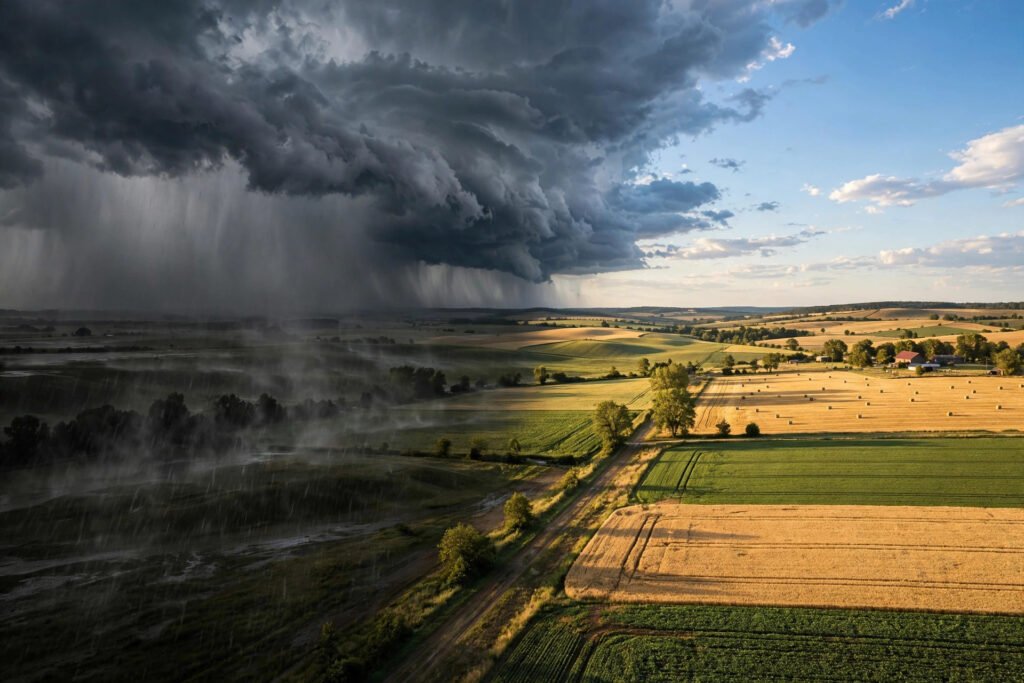
Weather vs. Climate: What’s the Difference? (Explained)
“It’s 72 degrees — beautiful weather!” “No, that’s just weather. The climate here is getting warmer.” Most people use “weather” and “climate” interchangeably, and most of the time it doesn’t matter. But the distinction is one of the most important ideas in all of environmental science — it’s the difference between a mood and a personality, and confusing them is behind an enormous share of public misunderstanding about everything from forecasts to global warming.
The Core Difference: Time and Place
Weather is what’s happening in the atmosphere right now, here: temperature, humidity, wind, precipitation, cloud cover over hours and days. Climate is the long-term pattern — typically 30 years of weather statistics for a region: average temperatures, typical rainfall, the timing of seasons. The classic line, often attributed to Mark Twain: “Climate is what you expect; weather is what you get.”
Think of it this way: weather is a single at-bat; climate is the batting average. One cold day doesn’t disprove a warming climate any more than one strikeout disproves a .300 hitter. Conversely, a record-hot summer doesn’t prove climate change by itself — it’s the decades-long trend of hotter summers that does. The National Oceanic and Atmospheric Administration explains the distinction as fundamental to its mission: the National Weather Service forecasts weather days ahead; NOAA’s climate programs track the patterns across decades.
Why the Confusion Matters
The weather-climate confusion is the engine of the most common climate misconceptions. “It snowed in April — so much for global warming” mistakes a weather event for a climate signal. The correct framing: a warming climate loads the dice toward more heat records and more intense precipitation, but weather’s natural variability still deals cold snaps and mild stretches. Climate change doesn’t eliminate winter; it shifts the odds.
The confusion also runs the other direction. A single extreme event — one hurricane, one heatwave — gets cited as proof of climate change, when scientists are careful to speak in terms of attribution: climate change made this type of event more likely or more intense, not that it “caused” it in isolation. NASA’s climate research emphasizes this probabilistic framing, and it’s worth internalizing: climate speaks in trends and odds, weather speaks in events.
How Scientists Measure Each
Weather measurement is immediate and dense: thousands of surface stations, weather balloons launched twice daily worldwide, Doppler radar, satellites imaging cloud systems in real time. Forecasts blend these observations into numerical models run on supercomputers — the reason 3-day forecasts are now remarkably accurate and 10-day forecasts remain fuzzy.
Climate measurement is patient and deep: the same station records averaged over 30-year “climate normals” (currently 1991–2020), plus proxies reaching back millennia — ice cores trapping ancient air, tree rings recording growing seasons, ocean sediments archiving temperatures. A single thermometer tells you weather; a century of thermometers, plus ice cores, tells you climate. The two toolkits barely overlap, which is why “it’s cold today” can never rebut a climate dataset.
Microclimates: Where They Meet
The most intuitive place the two concepts touch is the microclimate — your yard’s climate versus your region’s. A south-facing slope, a lakeshore, an urban heat island: these create persistent local patterns (climate) that shape daily conditions (weather). Chicago’s lakefront runs cooler on summer afternoons than O’Hare — that’s microclimate modulating weather, every single day.
Gardeners live this distinction: the USDA hardiness zone is climate (what you can expect to survive winter), while the late frost that kills your tomatoes in May is weather (what you got). Successful gardening — and farming, and city planning — means respecting both: choose for the climate, protect against the weather.
Using the Distinction in Real Life
Once you see it, the distinction clarifies decisions everywhere. Buying a house? Climate tells you about flood zones, heating costs, and insurance trends; weather tells you whether to bring an umbrella to the showing. Planning a vacation? Climate picks the destination and season; weather picks the packing list. Debating energy investments? Climate data justifies the heat pump; this week’s forecast doesn’t.
It also makes you a better consumer of news. Headlines about record temperatures are weather stories with climate context — the context being how the frequency of such records has shifted over decades. Ask of every dramatic weather story: is this a data point or a trend? One is interesting; the other is important. Dressing for the difference is its own art — layering for cold weather handles the weather, while choosing fabrics for hot, humid weather is really about dressing for your region’s climate.
Why Weather Forecasts Beat Climate Predictions (and Vice Versa)
Here’s a paradox that confuses people: meteorologists can predict next Tuesday’s temperature within a couple of degrees but can’t tell you whether next July will be hot. Climatologists can project 2050’s average summer temperature with useful accuracy but can’t tell you a single day’s weather that year. Both are doing their jobs correctly — they’re answering different questions.
Weather forecasting is an initial-conditions problem: measure today’s atmosphere precisely, simulate forward. Tiny measurement errors compound, which is why skill fades after about 10 days — the famous chaos limit. Climate projection is a boundary-conditions problem: you don’t need today’s clouds to know that more greenhouse gas means a warmer average; the physics of energy balance constrains the long-term outcome even as daily details stay unpredictable. Short-term precision and long-term accuracy are different skills, and the atmosphere grants them to different sciences.
Conclusion
Weather is the atmosphere’s mood today; climate is its personality over decades. One cold snap can’t refute a warming trend, one hot summer can’t prove it, and the scientists who study each use entirely different toolkits. Keeping the two straight doesn’t just win arguments — it makes you better at reading forecasts, planning trips, buying homes, and understanding the biggest environmental story of our time. Expect the climate; dress for the weather.
Frequently Asked Questions
What is the simple difference between weather and climate?
Weather describes short-term atmospheric conditions (hours to days); climate describes long-term patterns, typically 30-year averages of temperature, precipitation, and seasons for a region.
Can a cold winter disprove global warming?
No. A single season is weather — natural variability within the system. Climate change is measured in multi-decade trends, and warming increases the odds of heat extremes without eliminating cold snaps.
What is a climate normal?
A 30-year average of weather observations (currently 1991–2020) used as the baseline for a region’s climate. Scientists compare current conditions against normals to detect shifts.
Why are 10-day weather forecasts unreliable?
Because the atmosphere is chaotic: tiny errors in today’s measurements compound with each simulated day. Skill drops sharply after about a week — the mathematical limit of initial-conditions forecasting, not a failure of effort.
Is climate change just natural weather variation?
No. Natural variation operates within bounds set by the climate system, and scientists measure it precisely. The observed multi-decade warming trend — in thermometers, ocean heat, ice loss, and shifting seasons — falls far outside natural variability and matches the physics of added greenhouse gases.
How do scientists know about climate from thousands of years ago?
Through proxies: ice cores trap ancient air bubbles, tree rings record growing conditions, and ocean sediments preserve chemical temperature signatures — together building climate records stretching back hundreds of thousands of years.