How to Prevent Makeup From Melting in Summer Heat (Guide)
It is 95 degrees, humidity is at rainforest levels, and your carefully applied makeup is migrating south. Foundation pooling in pores, eyeliner smudging into watercolor, blush vanishing by noon — summer heat is makeup’s natural enemy. But melting makeup is not inevitable. It is a predictable chemistry problem (heat plus oil plus sweat equals product breakdown), and it has a predictable solution: the right prep, the right formulas, and the right setting strategy.
Here is how to prevent makeup from melting in summer heat: the prep routine that creates a heat-proof base, summer-specific formulas, the setting and layering order that locks everything down, and the midday rescue kit that revives melting makeup without starting over.
Prep: The Heat-Proof Base
Skincare for hot weather
Summer prep is about lightweight layers, not the rich winter routine. Switch to a gel or lightweight moisturizer — heavy creams plus heat equal instant slide. Let every layer absorb fully before the next; makeup applied over damp skincare melts on contact. A mattifying primer on the T-zone (and only the T-zone) controls the oil breakthrough that heat accelerates. Skip heavy oils in the morning routine entirely during heat waves.
Sunscreen that plays well with makeup
Sunscreen is non-negotiable in summer, but the wrong formula destroys makeup. Choose lightweight, mattifying, or “dry-touch” sunscreens — gel and fluid formulas layer best under cosmetics. Let sunscreen set for a full 10 to 15 minutes before makeup; this single wait is the most skipped and most impactful step. If your skin reacts to chemical filters in the heat, it is worth learning how to choose the right sunscreen for sensitive skin — mineral formulas are often calmer on heat-stressed skin.
Summer Formulas: What to Switch
Swap heavy full-coverage foundation for tinted moisturizer, skin tint, or long-wear lightweight foundation — less product means less to melt. Cream blushes and bronzers outlast powders in heat (powder plus sweat equals patchiness). Waterproof mascara and eyeliner are summer essentials, not options — regular formulas do not survive humidity. Lip stains beat lipstick (no melting, no feathering in heat). And consider skipping foundation entirely on the worst days: tinted SPF plus concealer where needed is the heat-wave uniform of everyone who has learned this lesson.
The Setting Strategy: Lock It Down
Layer in the right order
The heat-proof order: skincare (light, fully absorbed) → sunscreen (set 10–15 min) → primer (T-zone) → foundation (thin layers) → cream products → setting powder (light dusting, T-zone focus) → setting spray. Each layer must be thin — thick layers melt; thin layered films hold. This is the opposite of winter makeup, where richness is fine.
Powder and spray: the dynamic duo
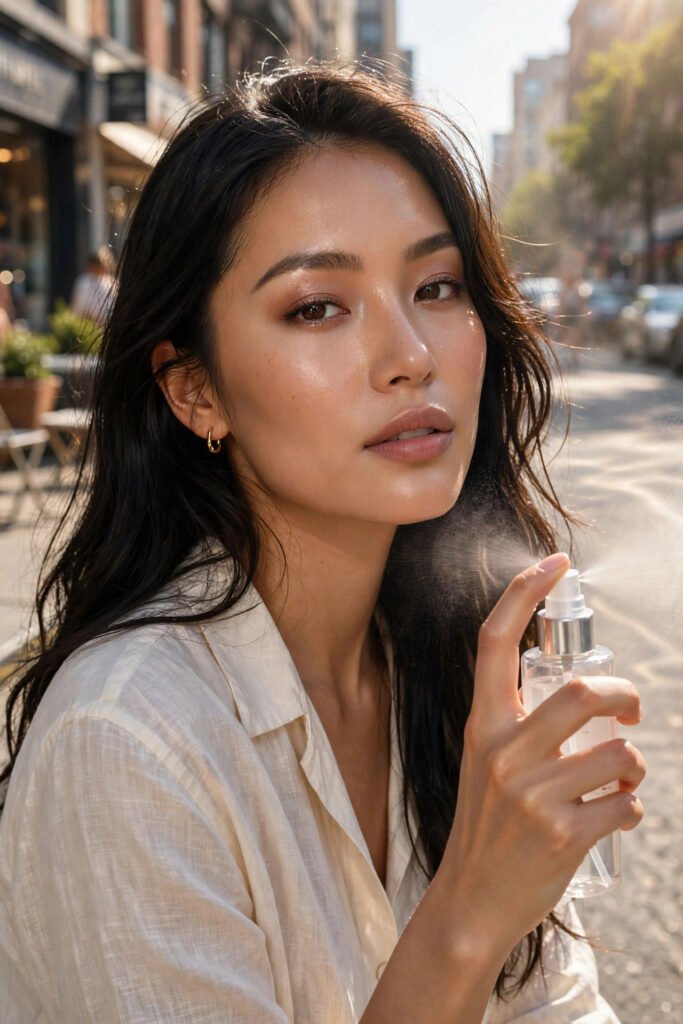
Translucent setting powder pressed (not swept) into the T-zone absorbs the oil that heat produces. Follow with a setting spray — not a refreshing mist, a true setting spray with film-forming polymers — applied in an X and T motion from arm’s length. The powder-spray combination is the highest-impact anti-melt step in the entire routine. For extreme days, the “sandwich” method (spray before and after powder) adds meaningful longevity.
The Midday Rescue Kit
Carry: blotting papers (lift oil without disturbing makeup — the number-one rescue tool), a travel setting spray, a pressed powder compact, and cotton swabs. The rescue sequence: blot (never rub — rubbing moves product), spot-fix with powder only where needed, mist lightly with setting spray, and let it dry without touching. Do not apply more foundation over melted makeup — it compounds the problem. Five minutes with blotting papers and spray restores what took 30 minutes to apply.
Lifestyle Adjustments
Some melting is environmental, not cosmetic. Carry a portable fan or cooling towel — lowering skin temperature directly reduces product breakdown. Avoid touching your face (hands transfer heat and oil). Choose water-resistant everything for outdoor events. And adjust expectations honestly: in 100-degree heat, even the best routine has limits — the goal is graceful endurance to evening, not 16-hour perfection. The American Academy of Dermatology notes that sunscreen reapplication every two hours matters more than any cosmetic concern — reapply SPF over makeup with powder or spray formats rather than skipping it. The Skin Cancer Foundation offers specific guidance on reapplying sunscreen over makeup, a summer skill worth learning.
Budget for the seasonal swap: summer formulas are a real (if modest) expense, so fold them into how much you budget for monthly self-care rather than panic-buying at the first heat wave.
Sweat-Proofing Eyes and Lips Specifically
Eyes melt first because the eyelids are the oiliest skin on the face. The heat-proof eye routine: eye primer (not face primer — eye-specific formulas grip better), waterproof cream shadow as a base, powder shadow pressed over it, waterproof liner, waterproof mascara. Set the under-eye area with a tiny amount of powder to prevent concealer creasing and migration. For the waterline, skip liner entirely in extreme heat — it will migrate no matter what; tightline the upper lash line instead for definition that stays.
Lips need their own strategy: lip stains are the heat-wave champions — they dye the lip rather than coating it, so there is nothing to melt or feather. If you prefer lipstick, line and fill with lip liner first (it anchors color), apply lipstick, blot, and set the edges with a touch of translucent powder. Gloss in extreme heat is a losing battle — save it for air conditioning. And keep lip products out of hot cars; melted lipstick bullets never fully recover their texture.
The car problem
Do not leave makeup in a hot car — heat degrades formulas, melts bullets, and breeds bacteria in liquid products. Carry what you need in your bag; the car is a sauna that destroys cosmetics. This applies to sunscreen too — a superheated bottle loses efficacy.
Know when to surrender gracefully
Some days defeat every product — 105 degrees with 90 percent humidity is one of them. On those days, the winning move is minimal makeup done well: tinted SPF, waterproof mascara, lip stain. Looking fresh with less beats looking melted with more, every time.
Conclusion
Preventing makeup from melting in summer heat means lightweight prep with fully absorbed layers, sunscreen given 10–15 minutes to set, summer-weight formulas (tints over full coverage, waterproof eye products, stains over lipstick), thin layered application locked with powder plus setting spray, and a blotting-paper rescue kit for midday. Heat is predictable; so is the defense. Build the routine once and every heat wave becomes manageable.
Frequently Asked Questions
Why does my makeup melt even with setting spray?
Usually the base layers: heavy skincare not fully absorbed, sunscreen applied immediately before makeup, or too-thick foundation layers. Setting spray locks in a good base — it cannot fix a melting foundation.
Should I skip foundation entirely in summer?
On extreme heat days, yes — tinted SPF plus concealer is the heat-proof choice. Save full foundation for air-conditioned evenings. Less product is the simplest anti-melt strategy.
How do I reapply sunscreen over makeup?
Use SPF powder, setting spray with SPF, or cushion compact SPF — pressed gently over makeup without disturbing it. Liquid sunscreen rubbed over makeup destroys the base; purpose-made over-makeup formats do not.
Does waterproof makeup really last longer in heat?
For eye products, dramatically — waterproof mascara and liner are the single biggest summer upgrade. For base products, “long-wear” matters more than “waterproof”; look for transfer-resistant and humidity-tested claims.