How to Handle a Dead Battery on a Road Trip (2026 Guide)
You turn the key — or press the button — and get that sickening click-click-click. The dashboard flickers and dies. You are 200 miles from home, the sun is going down, and your phone is at 18 percent. A dead battery on a road trip feels like a disaster, but it is actually one of the most solvable breakdowns on the road — if you know what to do in the right order.
This guide covers the immediate steps to get moving again, how to jump-start safely (including the order most people get wrong), when a jump will not save you, and how to make sure it never happens twice on the same trip.
First: Confirm It Is Actually the Battery
Not every no-start is a dead battery. Turn the key and listen: rapid clicking with dim or flickering dash lights is the classic dead-battery signature — the starter solenoid engaging without enough power to turn the engine. A single solid click with no cranking often means a bad starter. No sounds at all with completely dead electronics could be a failed battery connection or a blown main fuse.
Check the simple stuff first. Are the headlights left on? Is a dome light glowing? Try the horn — a weak, sad honk confirms low voltage. Pop the hood and look at the battery terminals: white or blue-green crusty corrosion can break the connection entirely, and sometimes just wiggling the cable (with the car off) restores contact. If the terminals are loose or corroded, that might be your whole problem.
How to Jump-Start Safely (the Right Order)
Flag down a fellow driver or call roadside assistance — most people are happy to help, and it takes five minutes. You will need jumper cables, which is why they belong in every emergency kit for your car. Even better: a portable lithium jump starter pack, which lets you self-rescue without another vehicle and costs $60 to $100.
The connection sequence
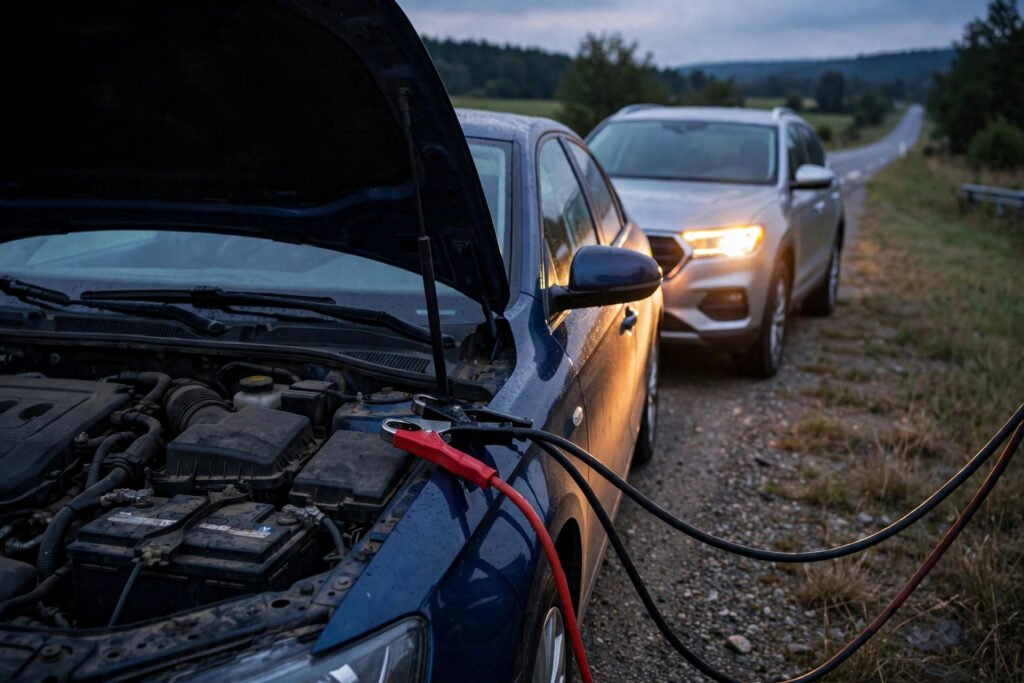
Park the working car close, both engines off. Connect RED to the dead battery’s positive (+) terminal. Connect the other RED end to the good battery’s positive (+). Connect BLACK to the good battery’s negative (−) terminal. Connect the final BLACK clamp to an unpainted metal surface on the dead car — a bolt on the engine block or frame — at least a foot from the battery. This last step matters: it keeps sparks away from battery gases.
Start the working car, let it run for two to three minutes, then try starting the dead car. If it starts, leave it running. Remove the cables in exact reverse order. Then drive for at least 20 to 30 minutes — highway speeds are best — to let the alternator recharge the battery. Do not just start it and turn it off again; a short idle will not restore a deeply discharged battery.
Jump starter packs
Connect red to positive, black to negative (or a ground point), turn the pack on, and start the car — no second vehicle needed. Keep the pack charged: check it every few months, because a dead jump starter is just an expensive paperweight. On a road trip, charge it from the car while driving so it is always ready.
When a Jump Will Not Save You
Sometimes the battery is not the problem, or it is a problem jumping cannot fix. If the car starts with a jump but dies the moment cables are removed, the alternator has likely failed — the car is running on battery alone and will strand you again within minutes. That is a tow-truck situation, not a jump situation.
If the battery is visibly swollen, cracked, or leaking, do not jump it — damaged batteries can vent explosive gas or leak acid. Batteries older than four to five years, especially in extreme heat or cold, often fail permanently; a jump might get you to the nearest auto parts store, where most will test and replace batteries free with purchase. And if jump attempts produce no response at all — no clicks, no lights — suspect a completely severed connection, a failed starter, or a deeper electrical fault.
Getting Help on the Road
If you have roadside assistance — through your auto insurer, AAA, or your car’s manufacturer — call them before improvising. Most plans cover jump-starts and towing, and the wait is usually 30 to 60 minutes. Your credit card may include roadside benefits you forgot about; check before you pay out of pocket.
No coverage? Call a local tow company or mobile battery service — many auto parts chains offer mobile battery delivery and installation. While waiting, stay with the vehicle if it is safe, keep hazard lights on, and conserve phone battery. If you are in an unfamiliar area, share your location with someone back home. Knowing how to pack for a long road trip — water, snacks, chargers — turns a two-hour wait from miserable to merely boring.
Preventing the Next Dead Battery
Most road-trip battery deaths are preventable. Before any long drive, have the battery tested — auto parts stores do it free in minutes, measuring cold-cranking amps against the battery’s rating. Replace batteries older than four years before a big trip; the $150 to $250 cost beats any roadside drama. Consumer Reports’ car battery ratings help you pick a replacement that survives extreme temperatures.
On the road, turn off headlights, dome lights, and accessories when parked — modern cars have battery-saver shutoffs, but phone chargers and dashcams plugged into always-on outlets drain steadily. In cold weather, a battery loses significant cranking power; parking in a garage or using a battery maintainer overnight at your destination keeps it healthy. And keep those terminals clean: a wire brush and five minutes twice a year prevents the corrosion that causes so many “mystery” no-starts.
Conclusion
A dead battery on a road trip is a 15-minute problem if you are prepared: diagnose the symptoms, jump-start in the correct order (or use a portable jump pack), drive 30 minutes to recharge, and know when to call for a tow instead — a car that dies the moment cables come off has an alternator problem, not a battery problem. Prevent the repeat with a pre-trip battery test, a replacement for any battery past four years, and a jump starter pack in the trunk. The open road is for adventure; your battery should not be part of it.
Frequently Asked Questions
How long should I drive after a jump-start?
At least 20 to 30 minutes at highway speeds. Idling alone does not generate enough alternator output to meaningfully recharge a deeply discharged battery. If the car struggles to restart after that drive, the battery needs replacement.
Can I jump-start a car in the rain?
Yes — 12-volt car batteries are not dangerous in rain the way household current is. Keep the cable clamps dry-ish, avoid standing in deep puddles, and proceed normally. The voltage is too low to shock you through wet skin in this configuration.
Will a portable jump starter work on a V8 or diesel?
Most quality packs handle V8 gas engines fine; diesels and large trucks need higher-capacity packs rated for their engine size. Check the pack’s rating against your engine before relying on it — an undersized pack will just click helplessly.
How do I know if it is the battery or the alternator?
The quick test: jump the car, remove cables, and turn on headlights and A/C. If it dies within minutes, the alternator is not charging — the car was running on battery alone. Auto parts stores test both free; get both checked rather than guessing.
Does a dead battery damage modern cars’ electronics?
A simple discharge does not. But repeated deep discharges shorten battery life, and voltage spikes from improper jump-starting (wrong order, reversed polarity) can damage sensitive modules. Follow the connection sequence exactly, every time.