Most Reliable Cars for Long Commutes: 2026 Top Picks
If you spend two hours a day behind the wheel, your car is not just transportation — it is your office on wheels, your rolling budget line, and the single machine your entire day depends on. A breakdown on the way to work is never just a repair bill; it is a missed meeting, a tow-truck wait on the shoulder of I-90, and a scramble for a loaner. For long-distance commuters, reliability is not a nice-to-have. It is the whole point.
This guide cuts through the marketing noise and names the cars that actually hold up when the miles pile on. We drew on long-term dependability data, owner-reported repair histories, and real-world commuting costs to build a list of vehicles that can swallow 20,000 to 25,000 miles a year without drama — and the specific things to check before you buy one.
What “Reliable for Commuting” Really Means
Powertrain simplicity
The most dependable commuters tend to have proven engines and transmissions with years of production history behind them. First-year powertrains and complex turbocharged setups fail more often and cost more to fix. This is one reason hybrids dominate every commuter-reliability ranking: their engines run fewer hours per mile, regenerative braking extends brake life dramatically, and the technology has been refined over two decades.
Predictable running costs
A reliable commuter is one whose maintenance schedule you can plan for, not dread. Timing chains instead of timing belts, brake pads that last 80,000 miles, tires in common sizes that do not cost $300 each — these boring details decide whether your car costs you $800 or $2,500 a year in upkeep. Fuel economy matters just as much: at 20,000 miles a year, the difference between 28 mpg and 47 mpg is roughly $1,100 a year in fuel savings.
Comfort that holds up over years
Seats that feel fine on a test drive can become torture devices by month six. Long-haul commuters should prioritize supportive seating, low cabin noise, and adaptive cruise control that genuinely reduces fatigue in stop-and-go traffic. These features also protect resale value, since used buyers prize them too.
Crash avoidance and safety tech
More miles mean more exposure. The Insurance Institute for Highway Safety’s Top Safety Pick ratings, automatic emergency braking, and blind-spot monitoring are worth real money for daily drivers.
The Most Reliable Long-Commute Cars for 2026
Toyota Camry Hybrid — the gold standard
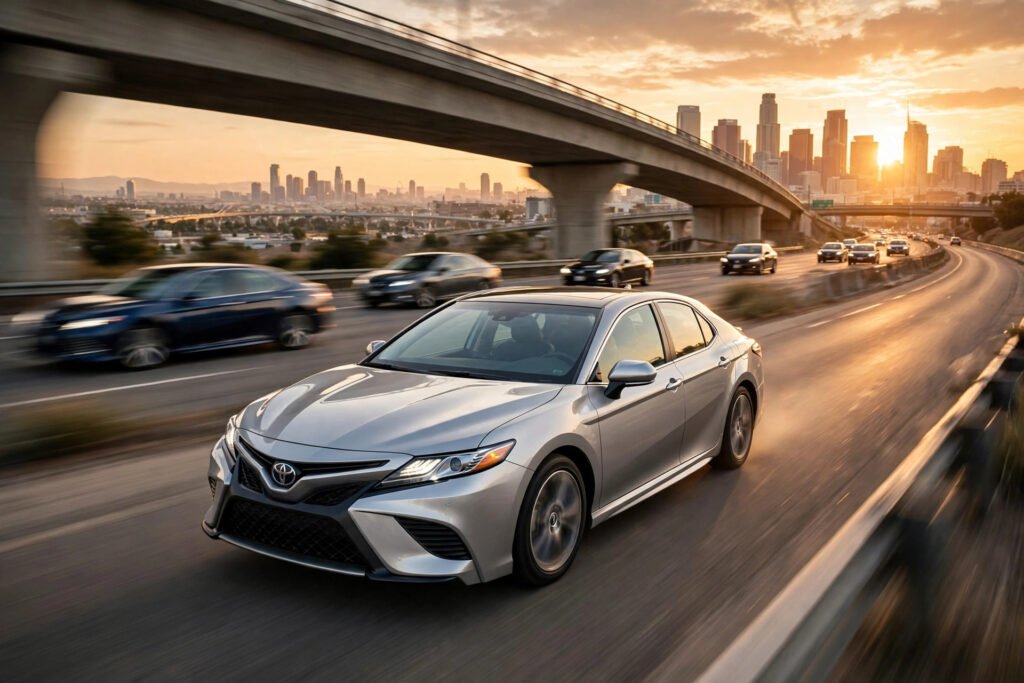
Year after year, the Toyota Camry Hybrid sits near the top of every dependability ranking, and for good reason. Its hybrid powertrain is one of the most proven systems on the road, owners routinely report 200,000-plus miles with nothing but routine maintenance, and real-world fuel economy hovers around 47 to 52 mpg depending on trim. The cabin is quiet, the seats are genuinely comfortable for tall drivers, and Toyota’s resale values mean you will get a healthy chunk of your money back when you sell. If there is one default answer to “what should I commute in,” this is it.
Honda Accord Hybrid — the driver’s commuter
The Accord Hybrid answers the same question with slightly sharper handling and a more upscale interior. Its two-motor hybrid system is among the smoothest in the segment, and Honda’s track record with four-cylinder engines is excellent. Owner surveys show the Accord holds up just as well as the Camry over 150,000-plus miles, with common repairs limited to consumables like brakes and batteries. It is the pick for commuters who actually enjoy driving.
Toyota Prius — the mileage king
The latest Prius is no longer the apologetic penalty box it once was. It looks sharp, drives better than it has any right to, and still returns 52 to 57 mpg in real-world commuting — meaning a 60-mile round trip costs under five dollars in fuel. Prius drivetrains have a legendary reputation: taxi fleets run them to 300,000 miles and beyond. For pure cost-per-mile commuting, nothing else comes close.
Honda Civic — the compact overachiever
If a midsize sedan feels like more car than you need, the Civic delivers nearly the same dependability in a smaller, cheaper package. The non-hybrid Civic’s 1.5-liter turbo has matured into a solid engine, the hybrid version pushes fuel economy past 50 mpg, and insurance and tire costs run noticeably lower than the midsize class.
Mazda3 and Hyundai Sonata Hybrid — the value alternatives
The Mazda3 earns standout owner-satisfaction scores for its premium-feeling interior and refined ride, and its conventional powertrains are among the simplest in the class — a real reliability advantage. The Hyundai Sonata Hybrid, meanwhile, offers Camry-rivaling efficiency with one of the best warranties in the business and typically lower purchase prices. Both deserve a test drive before you default to the obvious choices. Keeping any of these cars on schedule is easier when you know the easiest way to learn basic car maintenance, since DIY oil changes and filter swaps cut commuter running costs substantially.
Why Hybrids Dominate the Commuter Rankings
The data is unambiguous: hybrids are the most reliable powertrains for high-mileage driving, and it is not close. Brake pads on hybrids routinely last 100,000 miles because regenerative braking does most of the work. The gasoline engine spends less time running and under less strain, which extends its life. And because the hybrid system has been mass-produced for over twenty years, the failure modes are well understood and rare.
What the Reliability Data Actually Says
The J.D. Power U.S. Vehicle Dependability Study measures problems per 100 vehicles over three years of ownership, and mass-market Japanese brands consistently land at or near the top, with Toyota and Honda frequently leading. J.D. Power’s dependability ratings show the gap between the best and worst brands is enormous — often more than 100 problems per 100 vehicles.
Consumer Reports’ owner surveys tell the same story from a different angle: predicted reliability scores for the Camry, Accord, Prius, and Mazda3 routinely sit in the top tier, while vehicles with complex new turbocharged engines and continuously variable transmissions from less proven brands score worse. Consumer Reports’ car reliability rankings are worth checking model-by-model, because even good brands have occasional weak spots.
Models to Approach With Caution
Some popular commuter choices deserve a second look. Large luxury sedans and SUVs may feel great on the highway, but their maintenance costs are brutal at commuter mileages — a single dealer service visit can exceed $800. First-model-year vehicles of any brand carry elevated risk. And while turbocharged engines have improved, they still add heat, complexity, and potential repair costs that naturally aspirated and hybrid powertrains avoid.
How to Keep Your Commuter Reliable for 200,000 Miles
The right car is only half the equation. Follow the severe-service maintenance schedule in your owner’s manual (commuting in traffic qualifies as severe service), not the dealer’s upsell menu. Change transmission fluid on schedule — it is the most-skipped service and the most expensive to neglect. Keep tires properly inflated and rotated; underinflated tires alone can cost you 3 percent in fuel economy.
Finally, always travel prepared: a dead alternator at 6 a.m. on a rural highway is far less painful when you have an emergency kit for your car already packed in the trunk. Reliability is about preparation as much as it is about the car.
Conclusion
For long commutes, smart money goes to proven hybrids: the Toyota Camry Hybrid, Honda Accord Hybrid, and Toyota Prius top the list for dependability, fuel economy, and low running costs, with the Honda Civic, Mazda3, and Hyundai Sonata Hybrid offering excellent alternatives at different price points. Buy a proven powertrain, maintain it on the severe-service schedule, and your commuter will take care of you for 200,000 miles and beyond. The boring choice is the smart choice — and it is the one that gets you to work on time, every time.
Frequently Asked Questions
How many miles is too many for a commuter car?
Modern well-maintained cars routinely reach 200,000 miles, and reliable models like the Camry and Prius often exceed 300,000. What matters more than the odometer is maintenance history and condition — a well-kept 150,000-mile car can outlast a neglected 80,000-mile one.
Are hybrids more expensive to repair?
Hybrid-specific repairs are rare, and when they do occur, battery replacement costs have fallen to $2,000–$4,000 for most models, often with warranties covering 8–10 years or 100,000–150,000 miles. Routine maintenance on hybrids is typically cheaper because brakes and engines wear less.
Is it better to buy new or used for commuting?
A certified pre-owned commuter at 2–3 years old often delivers the best value: the steepest depreciation is behind it, but most of the warranty and reliable life remain. Avoid first-model-year used cars and verify maintenance records before buying.
Does adaptive cruise control really help on commutes?
Yes — studies and owner reports consistently show that adaptive cruise control with lane-centering significantly reduces driver fatigue in stop-and-go traffic, which is exactly where commuters spend their worst hours. It is one of the highest-value features you can get on a commuter car.