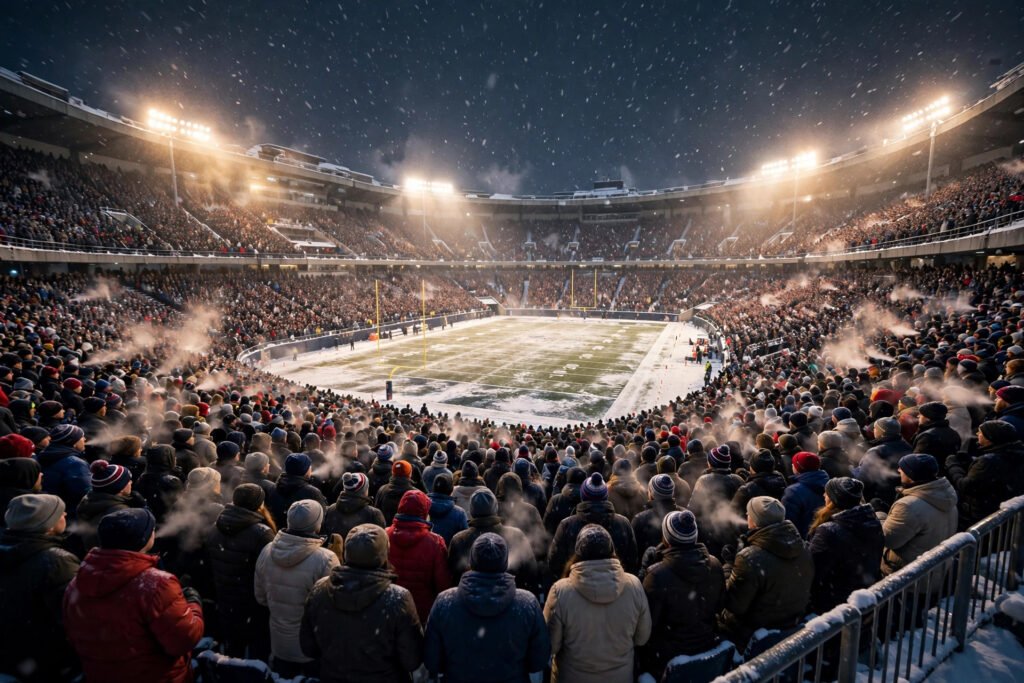
Why Lambeau Field Is So Hard for Visiting Teams
Lambeau Field is where visiting NFL teams go to have their seasons complicated. The numbers are stark: since the stadium opened in 1957, the Green Bay Packers have won roughly 70% of their home games, with December home records that border on the absurd. Opponents talk about Lambeau the way sailors talk about Cape Horn — with a respect that borders on superstition. But what actually makes it so hard?
This article breaks down the real reasons Lambeau Field is brutal for visiting teams — the weather, the crowd, the turf, the history, and the psychology — separating myth from measurable advantage. Because some of Lambeau’s mystique is real, and some of it is the most effective home-field propaganda in sports.
The Cold: Real, But Not How You Think
The famous cold is real — Lambeau has hosted the Ice Bowl (1967, -13°F at kickoff, -48°F wind chill) and the 2007 NFC Championship (-1°F). But here is the nuance: most Lambeau games are not that cold. September and October games are pleasant; even November averages in the 30s. The cold is a weapon in maybe 2-3 games a year — devastating in those games, irrelevant in the rest.
When it does hit, the advantage is physiological and well-documented: cold muscles are slower and more injury-prone, grip and dexterity deteriorate (quarterbacks lose feel, receivers drop balls), and kicking becomes unpredictable. The Packers practice in it all week; visitors arrive Saturday and spend Sunday in shock. Dome teams and warm-weather teams show measurably worse December Lambeau performances — the data supports the narrative here.
But modern advantages blunt the cold: heated benches, heated helmets, advanced cold-weather gear, and the stadium’s own under-field heating system (installed decades ago — the playing surface itself stays thawed). The cold punishes the unprepared, not the unequipped.
The Crowd: 80,000 Owners Who Never Leave
Lambeau’s crowd is structurally different from every other NFL crowd. The Packers are community-owned — 500,000+ shareholders, no single owner who can move the team. The season-ticket waiting list stretches decades (over 100,000 names), meaning the same families have held seats for generations. This is not a corporate crowd checking phones; it is a multigenerational congregation.
The effects: noise — Lambeau’s bowl design traps sound, and the crowd understands situational football (loud on opponent third downs, a sophistication fair-weather crowds lack). Loyalty through losing — the crowd does not empty in blowouts or bad seasons, denying visitors the demoralization-then-silence pattern of other stadiums. And intimacy — at ~81,000 capacity it is mid-sized by NFL standards, but the steep bowl puts fans on top of the field.
Visiting players consistently describe Lambeau’s atmosphere as distinct — less hostile than Philadelphia, more relentless. There is no quarter where the crowd gives up, which grinds on opponents psychologically across four quarters.
The Turf, the History, and the Aura
The surface: Lambeau’s natural grass (with synthetic reinforcement) plays differently than the artificial turf most visitors practice on — slightly slower, footing that changes with weather. It is meticulously maintained, but grass in December Wisconsin is still grass in December Wisconsin. Teams built on turf speed lose a step; the Packers build their roster for it.
The history: Thirteen championships, the Lombardi legacy literally named after their coach, the Ice Bowl, the “frozen tundra” mythology. Visiting teams walk past statues and through tunnels steeped in it. Sports psychologists call this place-based intimidation — and while it sounds soft, rookie and young teams demonstrably play tighter in historically imposing venues. The Packers’ official history and NFL Films have built this mythology deliberately and effectively.
The routine disruption: Green Bay is a small market — limited nightlife, cold weather, a focused-on-football atmosphere. Visiting teams find fewer distractions, which sounds like an advantage but actually removes the pressure-release valves road teams rely on. It is all football, all weekend, in the cold.
What the Numbers Actually Say
Strip away mythology and the measurable edges are: weather (2-4 games/year of genuine cold advantage, concentrated in December/January), crowd noise and persistence (real, every game), surface familiarity (marginal but real), and organizational stability (the Packers’ small-market structure produces unusual continuity — the same systems, the same expectations, decade after decade — which compounds home advantage over time).
What is not supported: the idea that Lambeau is magically harder than other elite home fields. Arrowhead, Seattle’s Lumen Field, and Buffalo in January produce comparable or larger measurable advantages in their own ways. Lambeau’s uniqueness is the combination — cold plus crowd plus history plus community ownership — sustained over 65+ years without interruption. No franchise relocation, no dome, no breaks in the tradition. That continuity is the real differentiator.
For fans planning pilgrimages: go in December for the full experience (dress for survival, not comfort), tour the Packers Hall of Fame, and understand you are visiting a working shrine, not just a stadium. And if you are a visiting fan, the locals are famously welcoming — the hostility is reserved for the scoreboard. Those following the league closely will also enjoy tracking how to watch games without cable — essential for out-of-market Packers games.
For fans, the Lambeau pilgrimage pairs naturally with the full game-day experience — and if you are hosting fellow fans for the watch party back home, knowing what a big-game party really costs helps you budget the spread. Whether you brave the frozen tundra in person or watch from a warm living room, understanding what makes Lambeau unique deepens every Packers game you will ever watch.
Conclusion
Lambeau Field is hard for visiting teams because of a compounding stack: genuine cold-weather advantage in winter games, a multigenerational community-owned crowd that never quits, a grass surface visitors do not practice on, and 65 years of unbroken mythology that tightens young opponents. No single factor is magic; together, continuously, they produce the NFL’s most distinctive home-field advantage. The frozen tundra is real — it is just more science and sociology than sorcery, and that makes it even harder to beat.
Frequently Asked Questions
What is the Packers’ home record at Lambeau Field?
The Packers have won roughly 70% of regular-season home games at Lambeau since 1957, with December/January home records among the best in NFL history. The advantage intensifies in cold-weather playoff games.
What was the coldest game at Lambeau Field?
The 1967 NFL Championship (“Ice Bowl”) — minus 13°F at kickoff with wind chills near minus 48°F. The 2007 NFC Championship (-1°F) is the coldest in the modern era.
Why are Packers fans called owners?
The Packers are the NFL’s only community-owned franchise, with 500,000+ shareholders holding stock (which carries no dividends or resale value — it is essentially a fandom certificate). This structure prevents relocation and creates the unique crowd culture.
Does the cold really affect NFL games at Lambeau?
Yes, measurably, in the coldest games: reduced dexterity, altered ball physics, footing changes, and injury risk all increase. Warm-weather and dome teams show the largest performance drops. In mild-weather games, the effect is negligible.
How long is the Packers season ticket waiting list?
Over 100,000 names deep, with waits estimated at 30+ years — effectively, you put your newborn on the list and hope. It is the longest waiting list in American sports.