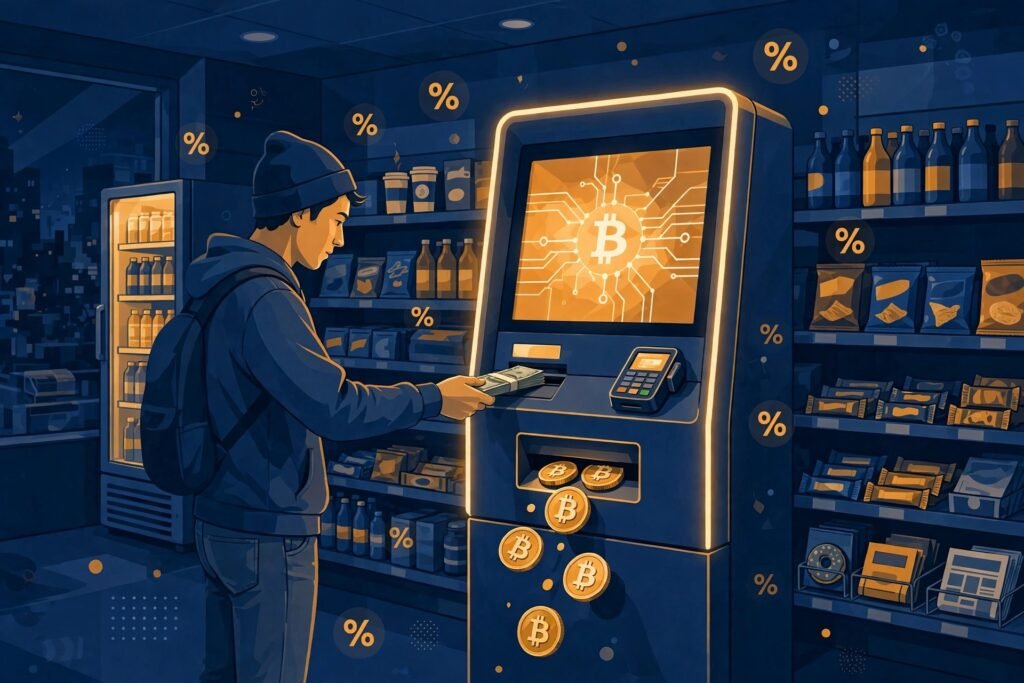
Crypto ATMs Explained: How They Work and Are Fees Worth It?
You have seen them in gas stations, convenience stores, and strip malls — glowing kiosks promising to turn your cash into Bitcoin in minutes. Crypto ATMs (more accurately, Bitcoin kiosks) now number in the tens of thousands across the United States, and for some buyers they are the most accessible on-ramp: no bank account, no week-long verification, just cash in and crypto out. But that convenience comes at a steep price, and the machines operate in a regulatory gray zone that has attracted both legitimate operators and outright scams. This guide explains exactly how crypto ATMs work, what they really cost, when they make sense, and how to avoid the traps.
How a Crypto ATM Works, Step by Step
- Find a machine — operator websites and aggregator maps list locations; most are in retail stores, open during business hours.
- Verify your identity — by law, U.S. operators must collect ID for transactions above certain thresholds (often starting around $900–$3,000, varying by operator and state). Expect to scan a driver’s license and sometimes take a selfie. Smaller amounts may need only a phone number for SMS verification.
- Enter your wallet address — either scan your wallet’s QR code or have the machine generate a paper wallet for you. Double-check the address; the machine will display it for confirmation.
- Insert cash — feed bills into the machine. The screen shows the exchange rate, the fee, and the exact crypto amount you will receive before you confirm.
- Confirm and receive — the operator broadcasts the transaction; crypto typically arrives in your wallet within 10–60 minutes depending on network congestion.
Two-way machines also work in reverse: send crypto to the machine’s address and receive cash. The process mirrors the buy flow with the same fee structure applied.
The Real Cost: Fees Broken Down
This is where the dream meets the receipt. Crypto ATM fees typically run 8–15% per transaction — combining an explicit operator fee with an exchange-rate markup (the rate you get versus the true market rate). On a $500 purchase at 12% all-in cost, you receive $440 worth of Bitcoin. Compare: Coinbase Advanced Trade (~0.5%), Kraken (~0.25%), ACH funding (free). The ATM costs roughly 20–50x more than an exchange for the same Bitcoin. Operators defend the fees citing rent, cash logistics, compliance costs, and convenience — and for small, urgent, cash-based purchases, some buyers accept the trade. But anyone with a bank account and a few days’ patience is dramatically overpaying. Before accepting any fee at face value, apply the skepticism from our guide to avoiding junk fees — the on-screen breakdown deserves the same scrutiny as a rental-car bill.
Limits, Verification, and Regulation
U.S. crypto ATMs operate under money-transmitter regulations: operators must register with FinCEN as money services businesses, implement anti-money-laundering programs, and comply with state licensing — Illinois, for example, brought kiosk operators under its Digital Assets and Consumer Protection Act registration requirements. Daily transaction limits typically range from $5,000–$25,000 depending on verification level. Regulators have increasingly scrutinized the sector: several states have investigated fee disclosures and fraud facilitated through kiosks (scammers directing victims to deposit cash into Bitcoin ATMs is a documented and growing crime pattern). Legitimate operators display their registration and fee schedules; machines with no operator identification, no fee disclosure, or “no ID required for any amount” claims should be avoided. The FinCEN guidance on virtual currency businesses outlines the federal framework, and the CFPB has warned specifically about scams involving crypto ATMs.
When a Crypto ATM Actually Makes Sense
- No bank account: the unbanked and underbanked can convert cash to crypto without any financial institution — the machines’ most legitimate use case.
- Cash-only situations: you have physical cash and need crypto quickly without depositing it first.
- Privacy preferences: smaller transactions require less documentation than exchange accounts (though not zero — and structuring transactions to evade reporting thresholds is illegal).
- Urgency: genuine time pressure where a 10% fee beats missing the opportunity — rare, but real.
When it does not make sense: regular investing (fees compound brutally), large amounts (percentage fees scale cruelly — 12% of $10,000 is $1,200), and anyone with ACH access and patience. For routine buys, an exchange is cheaper, safer, and better documented for taxes.
Scams Built Around Crypto ATMs
Crypto ATMs feature in some of the cruelest scams operating today:
- The “government/fraud department” scam: callers impersonating the IRS, FBI, or your bank claim your accounts are compromised and instruct you to withdraw cash and deposit it into a Bitcoin ATM “for safekeeping.” No government agency or bank will ever direct you to a crypto ATM. Hang up.
- Romance/investment scams: online relationships that pivot to “profitable crypto opportunities” requiring ATM deposits. The money is gone the moment it confirms.
- Fake QR codes: scammers provide a QR code “for your wallet” that is actually their address. Always generate the receiving address in your own wallet app.
- Overpayment scams: fake buyers “accidentally” overpay and ask you to refund the difference via ATM.
Ironclad rule: if anyone instructs you to use a crypto ATM — a caller, a new romantic interest, an “investment advisor” — it is a scam. Legitimate ATM use is always your own idea, on your own timeline. Before trusting any financial website or service, run the checks in our guide to verifying legitimacy.
Tips for Using One Safely
- Use machines from known operators (Bitcoin Depot, CoinFlip, Athena) with visible registration and support numbers.
- Read the full fee breakdown on screen before confirming — compare the offered rate to the live market price on your phone.
- Send a small test amount first when using a new machine.
- Bring your own wallet — do not use machine-generated paper wallets for significant amounts (they can be less secure and harder to back up).
- Keep the receipt; ATM purchases are taxable events when you later sell, and you will need the cost basis.
- Be aware of your surroundings — flashing cash at a kiosk in a convenience store at midnight is a personal-safety consideration, not just a financial one.
Conclusion
Crypto ATMs work exactly as advertised — cash in, Bitcoin out, in minutes, with no bank account required — but the 8–15% fees make them the most expensive legitimate way to buy crypto, suitable mainly for the unbanked, the cash-flush, or the genuinely urgent. For everyone else, an exchange with ACH funding delivers the same Bitcoin at a twentieth of the cost. And whatever you do, never use one at someone else’s instruction — that is not a transaction, it is a robbery you are being asked to commit against yourself.
Frequently Asked Questions
How much are crypto ATM fees?
Typically 8–15% all-in, combining operator fees and exchange-rate markups. Always check the on-screen breakdown and compare against the live market price before confirming.
Do I need ID to use a crypto ATM?
For larger amounts, yes — U.S. operators must verify identity above thresholds (often $900–$3,000+). Smaller purchases may require only phone verification. “No ID ever” machines are operating illegally.
How long does a crypto ATM transaction take?
The machine broadcasts immediately; blockchain confirmation typically takes 10–60 minutes depending on network congestion and the fee the operator attaches.
Can I sell Bitcoin for cash at a crypto ATM?
Two-way machines support this: send crypto to the machine’s address and receive cash. Expect the same steep fees in reverse, plus potential wait times for confirmations.
Are crypto ATMs safe?
Machines from registered operators are legitimate, but the sector attracts scams — particularly fraudsters directing victims to deposit cash. Never use one at someone else’s instruction, and verify the operator’s registration.