How to Set Stop Losses on Crypto Trades: A Practical Guide
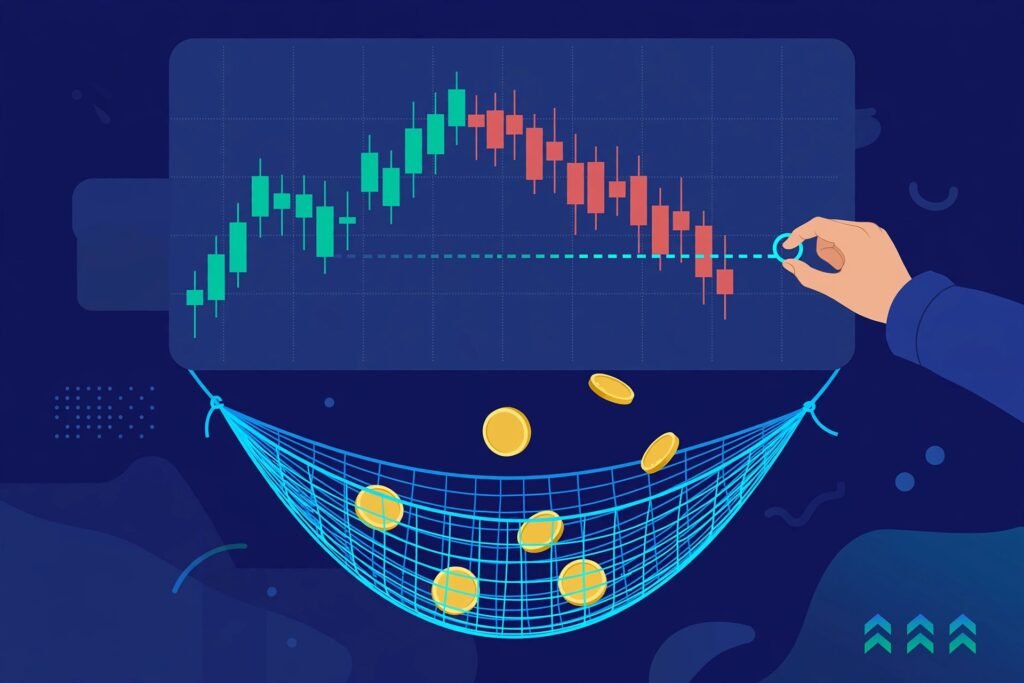
Crypto can drop 20% while you sleep. Without a plan, you wake up to a portfolio in ruins and make emotional decisions at the worst possible moment. A stop loss is that plan made automatic: a pre-set order that sells your position if the price falls to a level you chose while thinking clearly. It is the single most important risk-management tool in trading — more important than entry timing, more important than chart patterns. Yet most crypto traders either do not use stop losses or use them so badly they might as well not bother. This guide covers how stop losses actually work, where to place them, the order types that matter, and the psychological traps that turn a good tool into a guaranteed loss.
What a Stop Loss Is (and Isn’t)
A stop loss is an order instructing the exchange to sell your position if the price hits a specified trigger. It is not a prediction — it is an admission: “If the price reaches this level, my thesis is wrong, and I want out.” That framing matters. Beginners treat stop losses as pessimism; professionals treat them as the cost of staying in the game. No stop loss survives contact with a thesis that was actually wrong — the stop just makes the exit cheap and automatic instead of expensive and emotional. What a stop loss isn’t: a guarantee of your exact exit price (in fast crashes, slippage means you may sell below your trigger), protection against gaps (crypto trades 24/7, but low-liquidity alts can still gap through stops), or a substitute for position sizing.
Stop-Loss vs. Stop-Limit: Know the Difference
- Stop-loss (market): when triggered, sells immediately at the best available price. Guarantees execution, not price. In a flash crash, you will get out — possibly well below your trigger. Best for: traders who prioritize exiting over optimizing the exit price.
- Stop-limit: when triggered, places a limit order at your specified price. Guarantees price (or better), not execution — in a violent crash, the price can blow past your limit and leave you still holding. Best for: liquid markets where you want price control and accept small non-execution risk.
For most crypto traders on major coins, stop-loss (market) is the safer default — in crypto’s violent moves, guaranteed exit beats optimal exit. Use stop-limits only on highly liquid pairs where you are confident the order book can absorb your size near the trigger.
Where to Place Your Stop: The Methods That Work
Percentage-based stops
The simplest: risk a fixed percentage per trade, commonly 5–10% for crypto’s volatility (stock-style 2% stops get hunted constantly in crypto). A $1,000 position with an 8% stop risks $80. Clean, mechanical, and easy to backtest. The weakness: it ignores market structure — your stop may sit in the middle of normal noise.
Structure-based stops
Place stops below logical support levels — recent swing lows, consolidation boundaries, moving averages — rather than at round percentages. The logic: if price breaks structure, the thesis is genuinely broken; a mere percentage wiggle might be noise. Give the stop breathing room below the level (2–3%) to avoid being wicked out by normal volatility probing the level.
Volatility-based stops (ATR)
Use Average True Range — a measure of the asset’s typical movement — to set stops at 1.5–2x ATR below entry. This automatically widens stops for volatile altcoins and tightens them for stable large-caps. It is the most professional method and the one that best adapts across market conditions. Most charting platforms calculate ATR for you.
Time stops (the underrated one)
If a trade has not worked within your expected timeframe, exit — even if the stop was not hit. Capital tied up in a sideways position is capital not working elsewhere. Define your holding horizon before entry and honor it.
Position Sizing: The Math That Actually Protects You
Here is the formula professionals use: Position size = (Account risk) ÷ (Stop distance). If you risk 1% of a $10,000 account ($100) per trade and your stop is 10% below entry, your position is $1,000. This single formula matters more than stop placement itself — it ensures no single trade can meaningfully damage your account, which is what actually keeps traders alive through losing streaks. Ten consecutive losses at 1% risk each leave you down ~10% and fully capable of recovering; the same streak without sizing discipline ends accounts. Before worrying about entries, master this arithmetic. It is the same protective thinking behind protecting a business idea before launch — defense first, offense second.
Crypto-Specific Traps
- Wick hunts: crypto’s thin order books produce violent wicks that trigger stops before reversing. Mitigation: place stops below wick zones, not at obvious round numbers where everyone else’s stops cluster.
- Exchange outages during volatility: stops are useless if the exchange goes down during a crash. Mitigation: size positions so you survive even if stops fail; consider decentralized alternatives for critical hedges.
- Funding-rate bleed: on perpetual futures, holding through chop while paying funding erodes capital even without price movement. Stops do not protect against slow bleed — position sizing and time stops do.
- Stop-loss hunting by market makers: real in thin markets. Do not place stops at the obvious level everyone sees; tuck them where the structure genuinely breaks.
- Emotional stop-moving: widening a stop because “it’ll come back” converts a planned $100 loss into an unplanned $500 loss. The stop was set by your rational self; honor it. If you would not enter the trade fresh at the current price, you should not still be in it.
Protecting capital is a universal skill — whether it is trading positions or keeping valuables safe in risky environments, the principle is identical: decide your protection before you need it.
Putting It Together: A Complete Example
Account: $10,000. You want to buy SOL at $100. Recent swing low: $88, ATR suggests normal noise of ~$6. You set your stop at $85 (below structure with wick room, ~2.3x ATR). Risk per trade: 1% = $100. Position size: $100 ÷ 15% = ~$667 (about 6.67 SOL). If stopped out, you lose $100 — 1% of the account, a shrug. If SOL runs to $130, you make ~$200 on a 1:2 risk-reward. You can be wrong 60% of the time and still profit. That is what proper stop-loss methodology buys: survival plus positive expectancy, mechanically, without emotion. The Investor.gov trading basics cover these risk principles from a regulator’s perspective, as do the SEC’s investor bulletins on trading risks.
Conclusion
Stop losses work when they are part of a system: defined before entry, placed on structure or volatility (not round numbers), paired with position sizing that risks 1–2% per trade, and honored without exception. They fail when used as talismans — set arbitrarily, moved emotionally, or trusted to protect oversized positions. Review your stops periodically as trades develop: trailing a stop up behind a winner locks in profits while giving the position room to work. In crypto’s 24/7 volatility, the stop loss is not pessimism; it is the mechanism that lets you trade aggressively while sleeping soundly. Set it, size it, respect it — and let the math do the worrying for you.
Frequently Asked Questions
What percentage should I set my crypto stop loss at?
Typically 5–15% below entry for spot crypto, wider for volatile altcoins (10–20%) and tighter for Bitcoin (5–8%). Better yet, base it on market structure or ATR rather than a fixed percentage.
Should I use stop-loss or stop-limit orders?
Stop-loss (market) for guaranteed execution in crypto’s fast moves; stop-limit only on highly liquid pairs where you want price precision. Most traders should default to stop-loss market orders.
Can stop losses guarantee I won’t lose more than planned?
No — slippage in fast crashes and exchange outages can cause worse fills. They drastically reduce risk but cannot eliminate it; position sizing is the true backstop.
Why do my stop losses always get hit before the price reverses?
Your stops are likely at obvious levels (round numbers, just below support) where wick hunts and stop clusters live. Place them where structure genuinely breaks, with room for normal volatility.
Do professional traders use stop losses?
Universally — though pros often use mental stops with automated alerts, options hedges, or portfolio-level risk limits instead of exchange stop orders (which can reveal positioning). The principle is identical: pre-defined exits, honored mechanically.