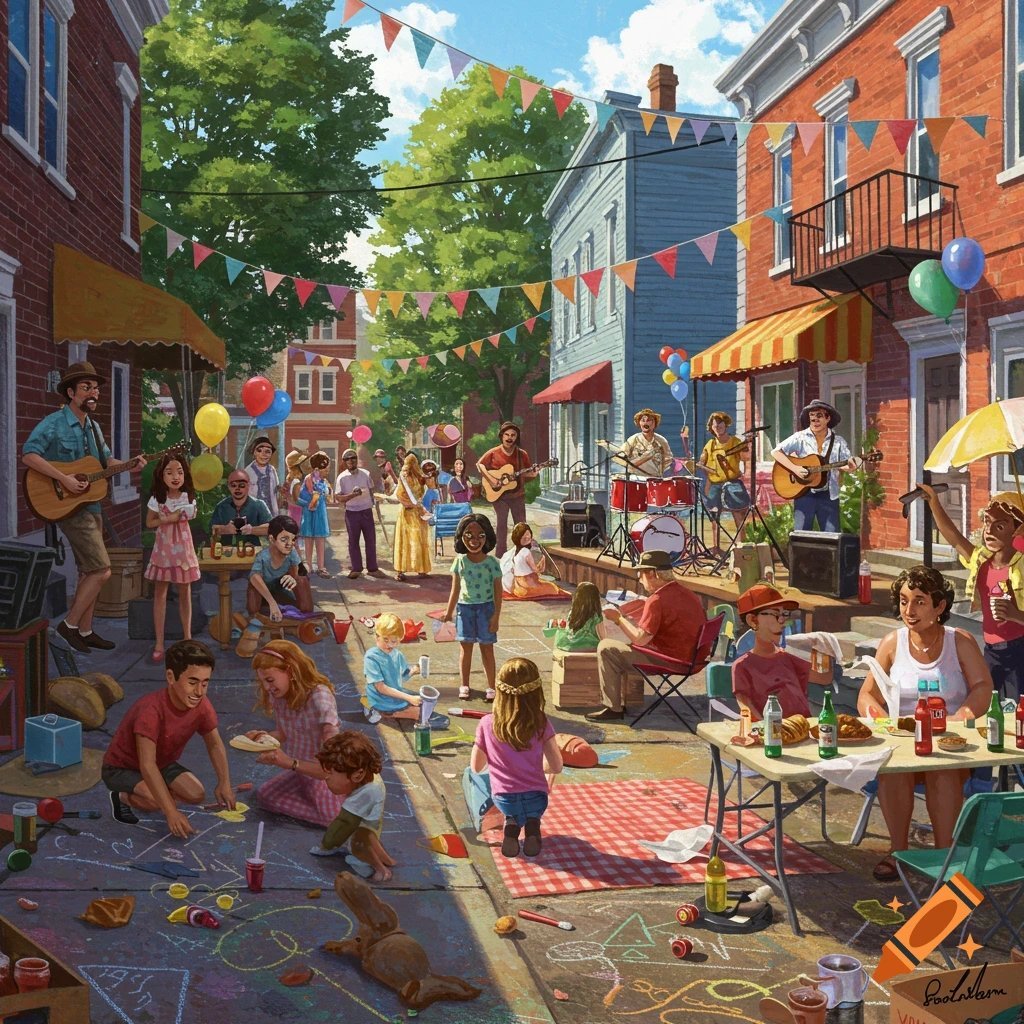
How to Organize a Neighborhood Block Party
How to Organize a Neighborhood Block Party (The 8-Week Timeline)
Learning how to organize a neighborhood block party is easier than you’d think — and it’s one of the highest-joy-per-effort events you can pull off. Block parties turn streets full of strangers-who-wave into actual communities. I’ve helped organize three, and the pattern is consistent: a little planning, a lot of potluck, and one person willing to be the point of contact. Here’s the complete 8-week timeline, from permits to cleanup.
Weeks 8-6: Foundation
- Gauge interest. Knock on doors or drop a simple flyer: “Block party idea — interested?” You need 5-10 enthusiastic households minimum. A group chat or email list starts here.
- Pick a date. Saturday afternoon (2-8 PM) is the sweet spot. Check for conflicts (holidays, big local events). Give 6-8 weeks notice.
- Check permit requirements. Most cities require a street-closure permit for blocking off the road — applications take 2-6 weeks and cost $25-100 (sometimes free). Search “[your city] block party permit.” You’ll typically need signatures from a percentage of residents on the block.
- Recruit 2-3 co-organizers. Don’t do this alone. Split roles: permits/logistics, food coordination, activities.
Weeks 6-4: Planning
- File the permit. Do this the moment you have signatures. Late permits are the #1 block-party killer.
- Plan the food: go potluck. The sign-up sheet is sacred — use a shared Google Doc with categories (mains, sides, desserts, drinks, supplies) so you don’t get 14 pasta salads. The organizers provide the main protein (grilled burgers/dogs or pulled pork) and everyone else fills in.
- Budget basics: $100-200 total covers permits, paper goods, and shared supplies — split among households or ask $10-15 per family. Keep it voluntary and transparent.
- Plan activities by age group (see below).
Weeks 4-2: Spreading the Word
- Flyers to every house on the block (and adjacent blocks) — paper still works best for this. Include date, time, what to bring, and a contact number.
- Digital too: Nextdoor, neighborhood Facebook groups, the group chat.
- Recruit volunteers for setup, grill duty, activity supervision, and cleanup. People are more willing than you expect — they just need to be asked.
- Confirm the permit and arrange barricades (the city usually provides or specifies these).
Week 1: Final Prep
- Confirm food sign-ups; fill gaps (buy what’s missing).
- Prep the activity stations; test anything borrowed (speakers, projectors for an evening movie).
- Buy supplies: paper goods, trash bags, name tags (seriously — name tags transform neighbor dynamics), first-aid basics.
- Send a reminder 3 days out with the schedule and what to bring.
Party Day: The Run of Show
- Morning: Set up barricades, tables, chairs, activity stations. Hang the banner.
- 2 PM: Kickoff. Music on, grill going, name tags out.
- 3-5 PM: Organized activities (see below).
- 5-7 PM: Potluck dinner. The main event — eat together.
- 7-8 PM: Wind down — dessert, group photo, casual hangout.
- 8 PM: Cleanup crew (pre-recruited!) restores the street. Leave it cleaner than you found it.
Activities for All Ages
- Kids: Bounce house rental ($150-250, split the cost), water balloons, face painting, chalk art zone, relay races.
- Teens: Cornhole tournament, basketball, teen-friendly competitions with prizes.
- Adults: Cornhole/horseshoes tournament, live music (is there a neighbor in a band?), trivia contest.
- Everyone: Pie-baking contest, pet parade, group photo, “how long have you lived here” icebreaker game.
The Takeaway
A great block party needs: a permit (file early!), potluck coordination, activities for every age, and a cleanup crew. Total organizer cost: $100-200 split among neighbors. The block party tradition exists because it works — streets that party together look out for each other. Start the group chat this week; your future community-minded self will thank you.
Frequently Asked Questions
Do I really need a permit for a block party?
If you’re closing a public street: yes, almost everywhere. The permit ensures emergency vehicle access plans, legal barricades, and liability coverage. Getting caught with an unpermitted street closure can mean fines and a shutdown mid-party. If you’re keeping it to driveways and yards without blocking the street, you typically don’t need one — but check local ordinances on amplified music and gathering sizes. When in doubt, call your city’s special events office; they’re usually helpful, not adversarial.
How do I handle neighbors who don’t want to participate?
Respect it completely — not everyone wants a party outside their door. Inform them early (not just invite — inform), give them the schedule and your phone number, and make reasonable accommodations (keep music directional, end on time). Never pressure or guilt-trip. Most non-participants are fine with the event as long as they’re informed and the street is restored after. The rare actively hostile neighbor: keep the organizers’ communication documented and make sure your permit is airtight.
What if it rains on block party day?
Have the rain plan decided in advance and communicated: postponement to a rain date (pick it when you pick the main date) or a scaled-down version (potluck moves to someone’s garage/driveway). Don’t try to “wait and see” the morning of — make the call by 9 AM so people can adjust. Pop-up canopies ($30-50 each) cover food tables in light rain but won’t save a full street party. The rain date on the original flyer prevents all confusion.
How do we split costs fairly?
Keep it simple and voluntary: suggest $10-15 per household, collected via Venmo/cash, covering permits, paper goods, and shared supplies. Publish what was collected and spent (a photo of receipts in the group chat). Don’t chase non-payers — voluntary means voluntary, and the goodwill matters more than $10. For big-ticket items (bounce house), get explicit commitments before booking. Potluck food is each household’s own contribution — no cost-splitting needed there.
Can renters participate in block party planning?
Absolutely — and they should be explicitly welcomed. Renters are often excluded by accident (flyers assume owners, planning happens in homeowner groups), which is a loss for everyone: renters are neighbors too, often for years. Practical inclusion: distribute flyers to every unit including apartments on the block, post in building common areas, and say “renters welcome” outright — the explicit invitation matters more than you’d think. Renters can co-organize, contribute potluck dishes, and volunteer like anyone else. The only wrinkle is the permit signature requirement in some cities, which may need property owners — but that’s paperwork, not participation. A block party that includes everyone builds the actual community; one that doesn’t is just a homeowners’ meeting with music.