How to Choose the Right Size When Shopping Online
How to Choose the Right Size When Shopping Online
Online shopping promised convenience and delivered a new anxiety: will it fit? With vanity sizing, inconsistent brands, and no fitting room, ordering clothes online can feel like gambling. The return rates prove it — online apparel returns run 30–40%, mostly for fit.
But getting the size right online is a learnable skill, not luck. I order most of my clothes online now with a return rate under 10%. Here’s the system.
Know Your Numbers: Measure Once, Order Confidently
Buy a soft measuring tape ($3) and record: bust/chest (fullest point), natural waist (narrowest point, usually at the navel level or above), hips (fullest point), inseam (crotch to ankle bone), and for tops, shoulder width and arm length. Update every year or after significant weight changes — bodies shift and memories don’t.
Measure over the undergarments you’ll wear with the clothes, stand naturally (don’t suck in — the clothes have to fit the real you), and have someone help with hard spots like shoulders. Write the numbers in your phone notes; you’ll reference them constantly. This five-minute task eliminates 80% of sizing guesswork permanently.
Learn your fit preferences in numbers too: do you like 2 inches of ease at the waist or 1? Knowing ‘I’m a 32 waist who likes relaxed fit’ translates across brands better than ‘I’m a medium’ — because medium means nothing consistent.
How Do I Choose the Right Size When Shopping for Clothes Online? Decode the Charts
Always check the specific garment’s size chart — not the brand’s general chart, the actual product page chart. Brands vary between lines (a brand’s petite line vs. main line), and the product chart reflects the actual garment’s measurements. Compare your numbers to the garment measurements, not the size labels.
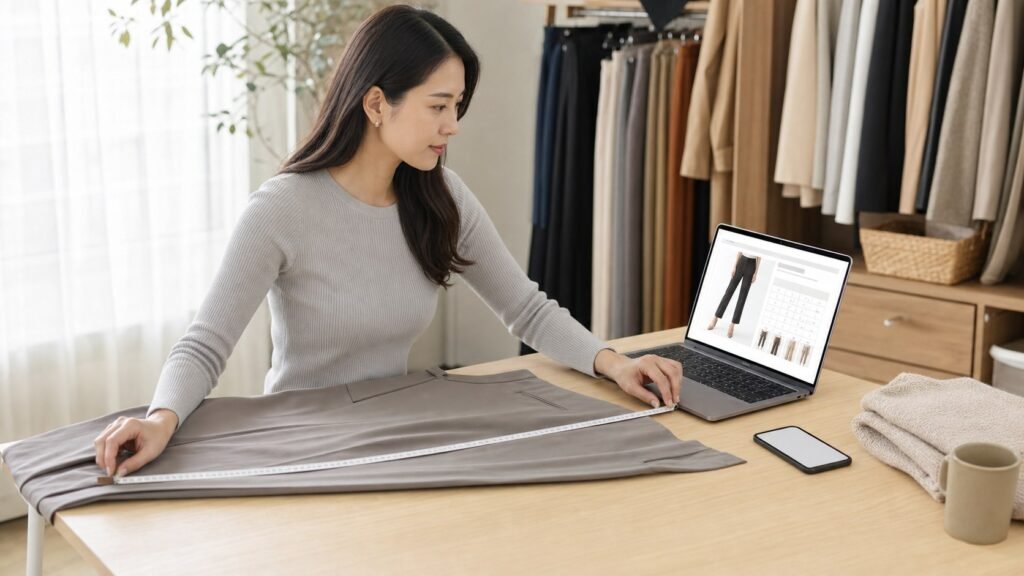
Understand ease: garment measurements include wearing ease beyond body measurements. A shirt with a 40″ chest measurement fits a 38″ chest with 2″ of ease (fitted) — compare garment specs to clothes you own that fit well. Lay your best-fitting jeans flat, measure them, and compare to online specs — this is the most reliable method in existence.
Read reviews like a detective: filter for reviewers near your size (‘I’m 5’4″, 150 lbs, bought the medium’) — these are gold. Look for patterns: ‘runs small’ from twenty reviewers means size up, period. Review photos on real bodies beat model shots; note the reviewer’s height and usual size. If reviews consistently mention an issue (tight shoulders, long torso), believe them.
Brand Intelligence and Fit Tools
Learn your brands: keep notes on how each fits you (‘Everlane tees run long, J.Crew pants run small in the waist’). After a few orders, you’ll predict new items accurately. Brands are remarkably consistent within their own lines — the inconsistency is between brands, which your notes solve.
Use fit-predictor tools when offered: True Fit, Fit Analytics, and brand-specific quizzes that compare against your past purchases or similar garments. They’re imperfect but directionally useful — better than guessing. Virtual try-on AR is improving fast for shoes and glasses; for clothing it’s still approximate, but worth a look.
Check the model stats: ‘model is 5’10” and wears size S’ tells you how the garment drapes at that proportion — compare to yourself. Fabric content predicts fit behavior: 100% cotton shrinks, stretch fabrics forgive, structured fabrics don’t. And always check the return policy before ordering — free returns make experimentation risk-free; restocking fees or final-sale items demand more certainty.
The Order Strategy That Minimizes Returns
When between sizes: size up for structured/non-stretch garments (tailoring down is easy), size down for stretchy casual knits (they relax with wear). For jeans, know the brand’s stretch recovery — high-stretch jeans often fit better sized down; rigid denim needs true size.
Bracket sizing for important purchases: order two sizes, keep one, return one — but only where returns are free and easy. Don’t abuse this (it costs retailers real money and drives up prices), but for wedding outfits, suits, and investment pieces, it’s the rational move. Just return the loser immediately.
Photograph and note everything: keep a phone note per brand with what you ordered, in what size, and how it fit. After six months you have a personal fit database that makes future orders nearly automatic. My notes app has entries like ‘BR chinos: 32×30 perfect; 32×32 too long’ — boring, invaluable. For understanding alterations when close-but-not-perfect, see our guide to Wirecutter's online shopping advice.
The Fit Journal: Your Personal Database
Start a phone note titled ‘Fit Notes’ and log every online purchase: brand, item, size ordered, and how it fit (‘J.Crew Ludlow blazer, 40R — shoulders perfect, sleeves 1 inch long’). After a dozen entries across brands, you own a personal fit database that makes future orders nearly automatic — you’ll know your size in each brand’s language, not just your own.
Include the qualitative details: ‘runs small in the waist,’ ‘long torso,’ ‘generous hips,’ ‘sleeves run short.’ These notes capture what size charts miss — the brand’s fit philosophy. Share relevant entries with friends who shop the same brands; fit intelligence is a gift economy. And update when your body changes — the journal’s value depends on currency.
The advanced version: photograph yourself in each kept item (front, side) and attach to the entry. Over time, you build a visual record of what silhouettes work on your body — the empirical foundation of personal style. The fit journal starts as a sizing tool and becomes a style tool. Six months of entries, and online shopping transforms from gambling to ordering.
Save this system as a note on your phone so it’s there every time you shop — after a month of using it, checking measurements and reviews becomes second nature, and online sizing stops feeling like a gamble.
The Takeaway
Measure yourself, use the product-specific size chart, mine reviews from similar bodies, and keep brand notes. That’s the whole system — no guessing.
When uncertain: size up in structured fabrics, down in stretch, and bracket important purchases. Your return rate will plummet.