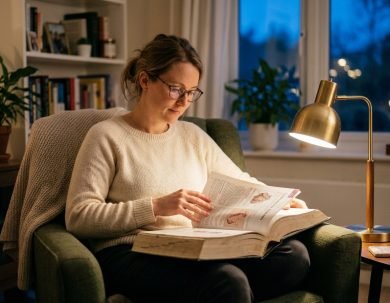
Do You Need Glasses — or Just Better Lighting?
Do You Need Glasses — or Just Better Lighting?
You’re squinting at your laptop at 9 p.m., the text looks fuzzy, and you catch yourself wondering: are my eyes going bad, or is this room just dim? It’s one of the most common vision questions out there, and the answer matters — because the fixes are completely different.
I went through this myself last year, convinced I needed glasses, and it turned out my home office lighting was genuinely terrible. Here’s how to sort out which problem you actually have.
The Quick Lighting Test
Before booking anything, run a simple experiment. Take whatever’s hard to read — your phone, a book, your laptop — into bright, natural daylight or under a strong lamp, and compare. If the text snaps into focus and the strain disappears in good light, lighting is likely your main problem. If it’s still blurry or you still squint, your eyes are telling you something.
Pay attention to when the trouble happens. Lighting problems show up in specific situations: reading in bed with one dim lamp, working at a screen in a dark room, cooking with the range hood light as your only source. Vision problems tend to follow you everywhere — the menu is blurry at the bright restaurant too, and road signs smear at noon just like at night.
Also check your screen habits. Staring at a backlit screen in a dark room forces your eyes to constantly adjust between bright and dark, which is exhausting. A simple bias light behind your monitor or a desk lamp in the room often fixes ‘evening eye strain’ overnight. I added a $25 LED desk lamp and my nightly headaches dropped by half.
How Do I Know If I Need Glasses or Just Better Lighting? Watch for These Signs
Some symptoms point pretty clearly at vision changes rather than ambiance. The big ones: holding your phone farther away to read it (classic presbyopia, usually starts in the 40s), squinting to see distance — road signs, the TV, faces across the room — frequent headaches after visual tasks, and one eye seeming worse than the other. Try covering each eye: if text is sharp with one and blurry with the other, that’s an eye issue, not a lamp issue.
Night driving trouble is another tell. If oncoming headlights have developed dramatic starbursts or halos that weren’t there a few years ago, get checked — that can signal astigmatism, early cataracts, or just a prescription that’s drifted. Lighting can’t fix halos.
Kids show it differently: sitting very close to the TV, rubbing eyes constantly, complaints of headaches after school, or a drop in reading enthusiasm. Teachers often spot vision problems before parents do. The American Academy of Ophthalmology on eye exams recommends regular eye exams for children, and a teacher’s note about squinting is worth taking seriously.
Fixing the Lighting (the Cheap Part)
Good task lighting is specific: bright enough to read comfortably, positioned to avoid glare and shadows. For reading, light should come over your shoulder — over the left shoulder for right-handed readers — so your hand doesn’t cast a shadow on the page. For desk work, a lamp to the side of your monitor at roughly screen height works well.
Color temperature matters more than people expect. Warm light (2700K) feels cozy but can make detail work harder; neutral to cool white (4000K–5000K) renders text more crisply. Many LED bulbs are adjustable now — try the cooler setting for your desk and keep warm light for the living room.
And the 20-20-20 rule helps regardless: every 20 minutes, look at something 20 feet away for 20 seconds. It relaxes the focusing muscle inside your eye. Set a timer until it’s habit — your eyes will thank you by evening.
When to Just Book the Exam
Here’s my rule of thumb: if better lighting doesn’t clearly fix it within a week, or if you have any of the red-flag symptoms above, book the exam. Vision changes creep up slowly, and people adapt without noticing — you don’t realize how bad it got until you put on the right correction and the world goes HD.
Adults with no symptoms should still get a baseline exam in their 20s and regular checks after 40, when age-related changes accelerate. And don’t self-diagnose with drugstore readers as a permanent solution — they’re fine as a stopgap for presbyopia, but they don’t correct astigmatism and they mask the need for a real check.
For a sense of what a proper exam involves and what it typically costs without coverage, see our breakdown of National Eye Institute eye health tips. Spoiler: it’s usually less than people fear.
Screen Settings That Reduce Eye Strain
Before blaming your eyes or your lamps, check the screen itself — it’s the thing you stare at for eight hours. Match screen brightness to your surroundings: the display shouldn’t glow like a beacon in a dim room or look washed out in bright light. Most operating systems have auto-brightness; turn it on, then fine-tune manually until the screen feels like paper, not a lightbulb.
Text size is the underused fix. Bump your system font scaling up one notch (125% on Windows, larger text on Mac) — if you’ve been squinting at tiny text for years, this alone can end evening headaches. Increase contrast rather than brightness when text looks gray: dark mode helps many people in dim rooms, though it’s personal preference, not medical advice.
Position matters too: the screen should be about arm’s length away, with the top at or slightly below eye level, tilted back slightly. A monitor riser or laptop stand plus external keyboard ($30 total) fixes the two most common ergonomic sins — screen too low and too close — in ten minutes. Your neck will thank you as much as your eyes.
The Takeaway
Test it first: better light, one week. If the squinting follows you into bright rooms, it’s your eyes — book the exam and don’t feel bad about it. Half of adults need some correction by middle age; it’s maintenance, not failure.
And fix the lighting anyway. Even people with perfect vision work better under a decent lamp.