What are the best AI apps for learning to cook
You want to cook better. Not “open a restaurant” better — just “stop ordering takeout four nights a week” better. Cooking classes are expensive and scheduled; YouTube is a firehose. So here’s a 2026 solution worth trying: AI apps for learning to cook that act as a patient, always-available cooking coach in your kitchen.
The honest verdict: they’re genuinely useful for beginners and intermediates, with some clear limitations. Here’s what’s worth your time.
The Best AI Apps for Learning to Cook: What They Do
Conversational Cooking Coaches (ChatGPT, Claude, Gemini)
The general chatbots are surprisingly excellent cooking teachers — and free. Their killer feature is real-time troubleshooting: “My sauce broke — how do I fix it?” “The chicken is done outside but raw inside, what did I do wrong?” “I don’t have buttermilk, what can I substitute?” Instant answers while your hands are covered in flour. No cookbook or video can do this.
Best prompts for learning:
- “Teach me to cook [dish] as a complete beginner. Break it into steps, explain the ‘why’ behind each technique, and warn me about common mistakes.”
- “I have [list ingredients]. What can I make? I’m a beginner, 30 minutes max.”
- “Explain the difference between sautéing, searing, and sweating — when do I use each?”
- “Create a 4-week plan to learn 8 fundamental techniques, one per session.”
Dedicated AI Cooking Apps
- AI recipe generators: input ingredients, dietary needs, and time; get customized recipes. Great for “what’s for dinner with what’s in the fridge” — which pairs with AI meal planning.
- Smart kitchen companions: apps that adjust recipes to your skill level, scale servings automatically, and convert units.
- Nutrition-focused AI: apps that analyze your meals’ nutrition and suggest improvements.
Voice Mode: The Underrated Kitchen Feature
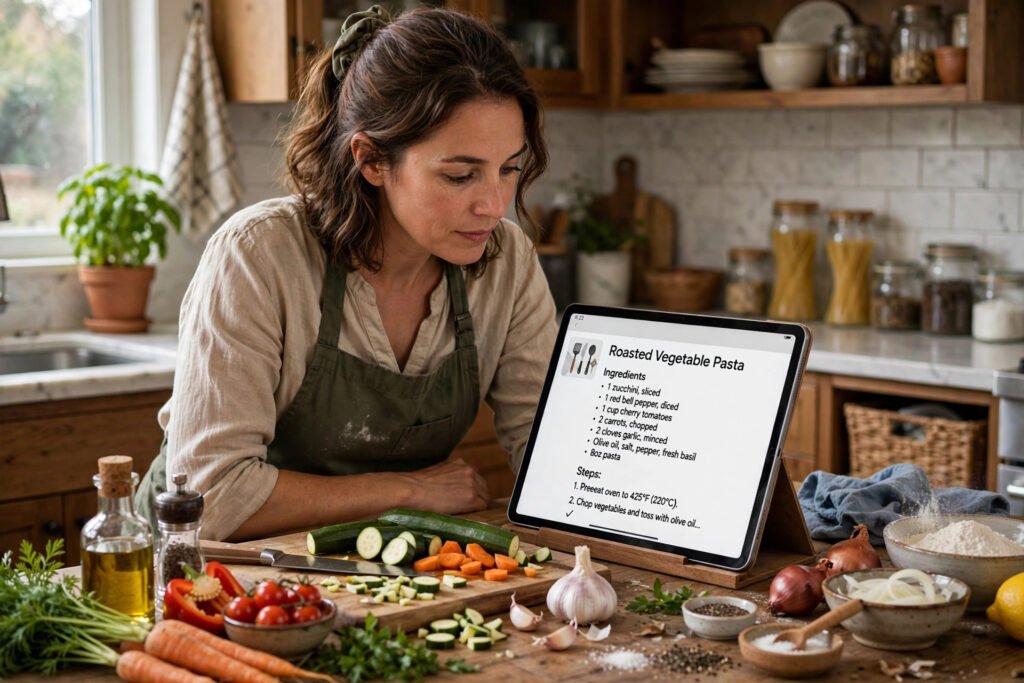
Voice-mode AI while cooking is transformative. Prop your phone up, start voice conversation, and cook hands-free: “What’s the next step?” “How do I know when the onions are done?” “Convert 350°F to Celsius.” It’s like having a cooking teacher standing next to you who never gets impatient. Try this once and you’ll understand the hype.
What AI Cooking Help Does Brilliantly
- Substitutions: the #1 beginner question, answered instantly and accurately.
- Technique explanations: “why” behind the “what” — understanding why you rest meat makes you a cook, not a recipe-follower.
- Scaling and converting: halving recipes, metric conversions, serving calculations — instant and error-free.
- Building fundamentals progressively: structured learning paths from “boil water” to “host dinner party.”
- Confidence: having answers on demand removes the fear that keeps beginners ordering pizza.
Where AI Falls Short (Know the Limits)
- It can’t taste. “Is this seasoned enough?” requires your tongue. AI can suggest how to taste and adjust, but the judgment is yours to develop.
- Verify food safety. AI occasionally suggests undercooked temperatures. Cross-check with FoodSafety.gov.
- Technique needs video too. AI describes knife skills well; watching a 2-minute video teaches them better. Combine both.
- Recipes need testing. AI-generated recipes are usually solid but occasionally have ratio errors. For important meals, test first.
A Beginner’s 30-Day AI Cooking Plan
- Week 1: knife skills + 3 simple recipes (pasta, stir-fry, sheet-pan dinner). Ask AI to explain every technique.
- Week 2: proteins — chicken breast (not dry!), eggs 3 ways, one fish dish.
- Week 3: sauces and flavor — one pan sauce, vinaigrette, basic curry or tomato sauce.
- Week 4: cook a full meal for someone. The accountability accelerates learning like nothing else.
AI for Dietary Restrictions and Health Goals
Generic cooking advice assumes you can eat anything. AI shines brightest when the constraints get complicated:
- Allergies and intolerances: “All my recipes need to be gluten-free and nut-free. Adapt this pasta recipe and flag any hidden gluten sources.” AI cross-references ingredients tirelessly — though always double-check labels yourself for severe allergies.
- Medical diets: “Create low-sodium dinners under 500mg per serving.” Useful for hypertension management (see our blood pressure guide) — but verify with your doctor or dietitian for serious conditions.
- Diabetes-friendly: “Meals with estimated carb counts and glycemic load notes.” AI estimates are starting points, not medical advice.
- Vegetarian/vegan transitions: “I’m going vegetarian. Convert my 5 favorite meat meals to vegetarian versions with similar protein.” The protein-matching is the hard part, and AI handles it well.
- Weight goals: “High-protein, 1800-calorie day of eating with 30-minute-max prep.” Pair with our exercise timing guide for the full picture.
Beyond Recipes: AI as Kitchen Sous-Chef
- Meal-prep planning: “I have 2 hours on Sunday. Design a meal-prep session yielding 10 lunches: what to cook in what order, using 2 sheet pans and 1 pot.” The sequencing optimization is genuinely impressive.
- Pantry management: “Here’s what’s in my pantry [list]. What 5 staples should I add to maximize meal options?”
- Rescue missions: “I over-salted the soup.” “My bread didn’t rise.” “The curry is too spicy.” Real-time troubleshooting while cooking — this alone justifies keeping a chatbot in the kitchen.
- Dinner party planning: “Plan a 3-course dinner for 6: one vegetarian, one gluten-free guest. Timeline working backward from 7 PM serving.”
- Kid-friendly stealth health: “Hide vegetables in meals a picky 6-year-old will eat. No ‘green stuff visible’ rule.”
- Budget optimization: “What are the cheapest high-protein dinners I can make this week?”
One More Thing: The 30-Day Cooking Challenge
Knowledge without action is trivia. Here’s your challenge: cook 4 dinners a week for the next month using AI as your coach — voice mode on, questions flowing, techniques explained in real time. By day 30, you won’t just have 16 meals under your belt; you’ll have judgment — the ability to improvise, substitute, and rescue. That’s the difference between following recipes and knowing how to cook. Start tonight.
The Bottom Line on AI Cooking Apps
The best AI apps for learning to cook combine conversational troubleshooting (the general chatbots, free) with dedicated recipe and planning tools — but the real breakthrough is voice mode in the kitchen, giving you a patient teacher exactly when you need one. Start with what you have: open a chatbot, say “teach me to cook dinner tonight,” and follow along. Verify food-safety details independently, supplement technique with video, and cook for someone by week four. In a month, you’ll wonder why you ever thought cooking was hard. For the meal-planning side, our AI meal planning guide completes the picture.