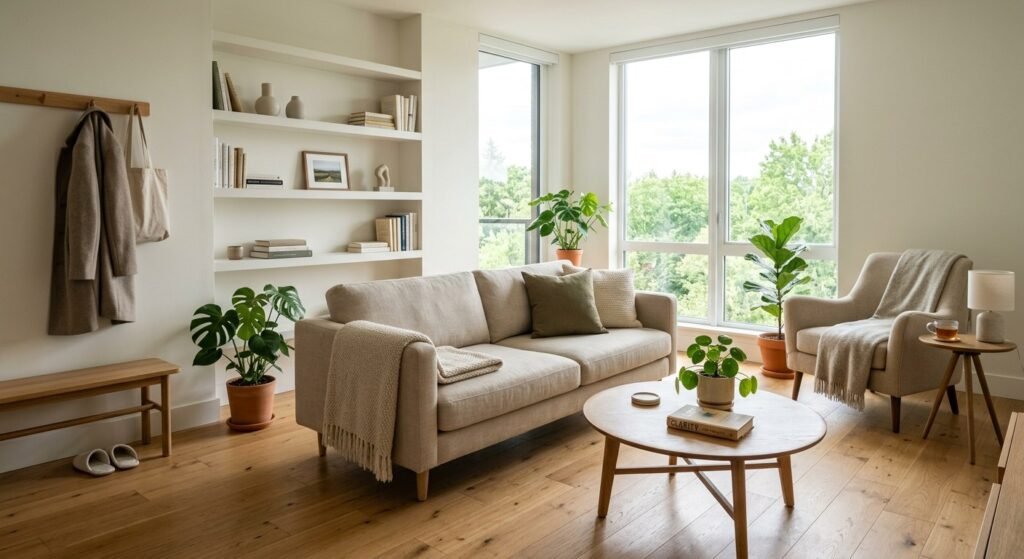
How can AI help me declutter and organize my home
Every closet is full. The junk drawer has evolved into junk drawers (plural). You’ve watched the organizing shows, bought the bins, and somehow the clutter always returns. Here’s an idea you might not have considered: AI can help you declutter and organize your home — not by magically tidying (we’re still waiting on that robot), but by solving the decision problem, which is where decluttering actually stalls.
Think about it: the physical act of putting things in bags is easy. The hard part is the thousand micro-decisions — keep or toss? Where does this live? That’s cognitive labor, and it’s exactly what AI is good at offloading. Here’s how.
How AI Can Help You Declutter and Organize Your Home: The Decision Engine
1. The Keep-or-Toss Coach
Decision fatigue kills decluttering sessions. AI acts as an impartial judge: “I have a bread maker used twice in 3 years, a box of cables for devices I don’t own, and 40 coffee mugs for a 2-person household. Help me decide what to keep using practical criteria.” The AI applies frameworks (used in the last year? duplicates? broken? sentimental or just guilt?) without the emotional attachment that paralyzes you.
2. Room-by-Room Battle Plans
“Declutter the house” is overwhelming. “Declutter the kitchen in 5 sessions” is doable. Prompt: “Create a 4-week decluttering plan for a 3-bedroom house: which areas in which order, 30-minute sessions, starting with highest-impact areas.” AI sequences the work sensibly (high-traffic areas first for motivation, sentimental items last).
3. The “Where Does This Go?” Problem
Clutter is often just homelessness — items with no designated spot. AI helps design homes for everything: “Design a landing zone for a family of 4 near the front door: keys, bags, shoes, mail, kids’ school stuff. Small space, rental-friendly.” Or photograph a messy area and ask for reorganization ideas.
4. Selling and Donating Logistics
Decision made — now the stuff has to leave. AI streamlines the exit: “Write 5 Facebook Marketplace listings for these items: [describe]. Include fair prices based on used condition.” For donations: “What organizations near [city] accept furniture donations with pickup?”
5. Maintaining the System
Decluttering fails without maintenance. AI helps build the habits: “Create a 15-minute nightly reset routine for a family kitchen.” Systems beat willpower — and AI is good at designing systems.
What AI Can’t Do (The Honest Limits)
- It can’t make sentimental decisions for you. AI can ask the questions, but only you know whether Grandma’s vase sparks joy or guilt.
- It can’t do the physical work. The bags still need carrying.
- It doesn’t know your space. Verify AI’s layout suggestions against reality before buying furniture.
- Beware the organization-product upsell. The best organizing system is usually fewer things, not more bins.
The Weekend Declutter Sprint (AI-Assisted)
- Friday night (20 min): generate your room-by-room plan and gather supplies.
- Saturday (3 hours): two 90-minute sessions with breaks. One category at a time. Photograph “before” shots.
- Sunday (2 hours): finish the category, list sellable items (AI-written listings), schedule donation pickup.
- Ongoing: 15-minute nightly resets, one-in-one-out rule, quarterly mini-declutters.
The Psychology of Clutter (Why Your Brain Hates Mess)
Clutter isn’t just ugly — it’s cognitively expensive. Research consistently shows:
- Visual clutter competes for attention. Every object in your visual field is something your brain processes, even unconsciously. A messy room literally reduces your working memory capacity.
- Clutter raises cortisol. Studies link cluttered homes to higher stress hormones, particularly in women. Your mess is chemically stressing you out.
- Clutter causes decision fatigue. “Where are my keys?” “Which of these 40 mugs?” — dozens of micro-decisions daily, draining the same mental battery you need for important choices.
- Cluttered spaces reduce generosity and healthy choices. (Yes, researchers studied this.) Orderly environments nudge better behavior.
Understanding this reframes decluttering: it’s not vanity or aesthetics — it’s mental health maintenance. The 30 minutes you spend clearing your desk pays back in focus for weeks.
Room-by-Room Quick Wins (Start Here Today)
- Entryway (15 min): one basket for keys/wallets, hooks for daily bags, a shoe limit (if they don’t fit the rack, some go). First impressions of your home start here — including yours.
- Kitchen counters (20 min): counters should hold only daily-use items. Everything else lives in cabinets. Clear counters make a kitchen feel twice as big.
- Nightstand (10 min): lamp, book, water, charger. That’s it. You sleep better in visual calm.
- Bathroom (15 min): toss expired products (check dates — old sunscreen and medications lose effectiveness), corral daily items in one tray.
- The car (20 min): trash bag, glove box purge, trunk reorganization. You spend hours here weekly; it counts as a room.
Do one quick win today. Momentum from a single cleared surface outperforms a perfect whole-house plan that never starts.
Quick Answers: Decluttering FAQs
How do I declutter sentimental items without guilt?
Separate the memory from the object: take a photo of the item, write down the story it holds, then let the physical thing go. You’re keeping the memory, not the clutter. For truly precious items, designate one “memory box” with a fixed size — when it’s full, something goes before something new enters. The American Psychological Association’s resources on stress and mental health discuss how our environments affect wellbeing — decluttering is genuinely therapeutic, not just aesthetic. And for the photos you’re preserving, our AI photo organization guide keeps the digital memories findable.
What if my partner/family won’t declutter with me?
Declutter only your own things first — nothing kills the project like throwing away someone else’s stuff. Your visible results often inspire cooperation within weeks. Establish shared rules going forward (one-in-one-out, 15-minute nightly resets) rather than re-litigating the past. And accept different thresholds: the goal is a functional home, not converting everyone to minimalism.
The Bottom Line on AI Decluttering
AI can help you declutter and organize your home by handling the hardest part — the decisions. Use it as a keep-or-toss coach, a room-by-room planner, a listing writer, and a systems designer; keep the sentimental calls and the physical work for yourself. The goal isn’t a magazine home; it’s a home where everything has a place and you can find your keys. Start with one drawer tonight — ask AI for a plan, set a timer for 30 minutes, and feel the momentum. For more on AI handling life’s logistics, see AI meal planning.