How do I use AI to summarize long articles quickly
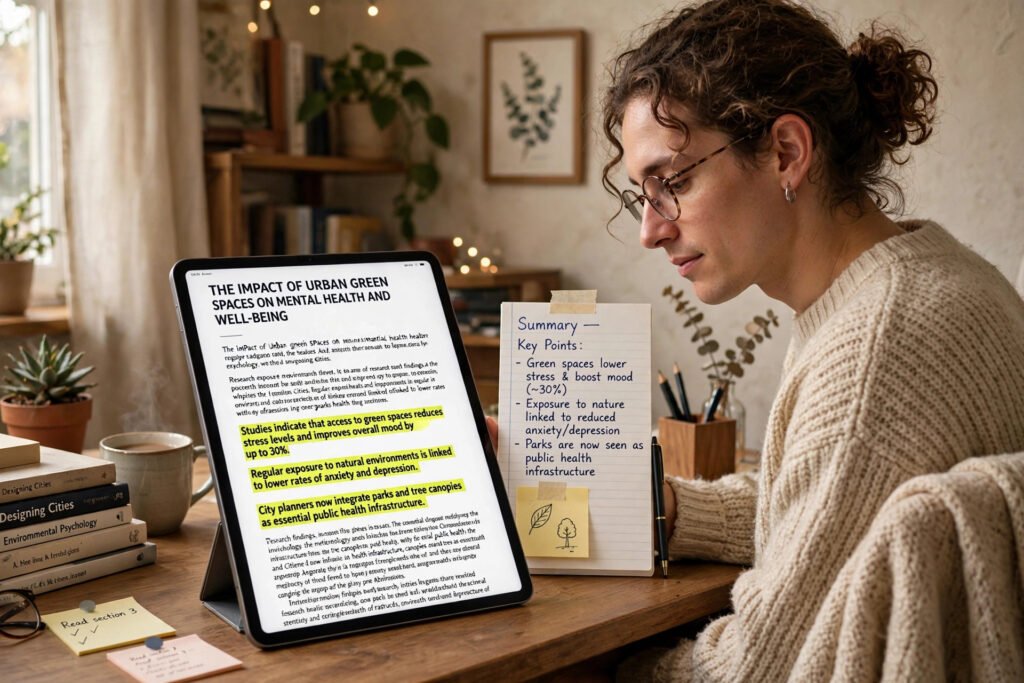
Someone sends you a 5,000-word article. “Thought you’d find this interesting!” You don’t have 20 minutes. You have 20 seconds. This is the quintessential modern problem — and AI summarizes long articles quickly better than almost any other task. It’s fast, it’s easy, and there are right and wrong ways to do it.
How to Use AI to Summarize Long Articles Quickly: The Methods
Method 1: Paste and Prompt (Universal)
Copy the article text, paste it into any chatbot, and use one of these prompts:
- The executive brief: “Summarize this article in 3 bullet points, max 20 words each, plus one sentence on why it matters.”
- The deep skim: “Give me: the main argument, 3 key supporting points, and any important caveats. Under 150 words.”
- The action extraction: “What are the actionable takeaways from this article? List only things I can actually do.”
- The skeptic: “Summarize this article’s claims, then tell me what evidence it provides vs. what it merely asserts.”
Method 2: URL Summarizers (Fastest)
- ChatGPT / Claude with browsing: paste the URL directly (works on many sites; paywalled content varies).
- Browser AI sidebars: Edge, Chrome, and Arc have built-in “summarize this page” features — one click, no copy-paste.
- Dedicated tools: apps like Shortform or Blinkist offer human-curated summaries for books; for articles, the general chatbots suffice.
Method 3: The Progressive Deep-Dive
For articles that matter: summarize first, then interrogate.
- “Summarize this in 5 bullets.”
- “Expand on point 3 — what evidence does the author give?”
- “What are the strongest counterarguments to this article’s thesis?”
- “What questions does this article leave unanswered?”
This turns a 20-minute read into a 5-minute interactive briefing that’s often more insightful than reading straight through — because you’re engaging critically instead of passively absorbing.
When Summaries Work Great
- Triage: deciding which of 10 articles deserve your full attention. Summarize all, read 2.
- Meeting prep: “everyone read this” becomes “here’s what it says and why it matters for us.”
- Research: surveying a field quickly before deep-diving into the key papers.
- Staying current: newsletters and industry news, compressed.
When to Read the Whole Thing
- Nuance matters: legal documents, medical information, anything you’ll act on. Summaries compress away caveats — and caveats are where the truth lives.
- It’s beautifully written: some articles are worth reading for the craft. AI summaries are nutritious; the original is the meal.
- You need to cite it: never cite a summary. Read the source.
- Learning deeply: summaries give you the conclusions; reading builds the understanding. For anything you’re studying seriously, read.
Accuracy Notes
- Verify surprising claims against the source text — AI occasionally misrepresents or invents details.
- Watch for bias: ask for “the article’s argument AND the best counterargument” to avoid one-sided compression.
- Longer isn’t always lossier: a 300-word summary of a 5,000-word article preserves more nuance than a 50-word one. Match length to importance.
- For general prompting skill that improves every summary, see our prompt-writing guide.
AI Summarization: Frequently Asked Questions
Can AI summarize YouTube videos and podcasts?
Yes — several ways. Paste the transcript (many videos have auto-generated ones) into a chatbot. Use browser AI sidebars that summarize the current page, including video pages. Or use dedicated tools that process video/audio URLs directly. The same prompting principles apply: “Summarize the main arguments in 5 bullets, plus any actionable advice.” A 2-hour podcast becomes a 3-minute brief — then listen fully only to the ones worth your time. For email threads specifically, our AI email management guide covers inbox triage techniques.
How do I summarize without losing important nuance?
Match summary length to importance: a 300-word summary preserves far more nuance than a 50-word one. Ask for structure that preserves complexity: “Summarize the argument, then list the author’s key evidence, then note the strongest counterargument.” And for anything you’ll act on — legal, medical, financial — read the original. Summaries compress away caveats, and caveats are where truth lives. For background on how these systems process text, see Wikipedia’s AI overview.
Can AI summarize books?
It can summarize famous books well (they’re in its training data) and unfamiliar books poorly (it’ll skim or hallucinate). For books you own digitally, paste chapters in sections. But honestly: books worth reading are worth reading. Use AI summaries to decide which books deserve your time (triage), then read the winners fully. A summary gives you conclusions; reading builds understanding. For nonfiction, the “summary first, then read selectively” combo is remarkably efficient.
What’s the best prompt for summarizing research papers?
This one: “Summarize this paper for a smart non-specialist: (1) the research question, (2) the method in plain language, (3) the key findings with numbers, (4) the limitations the authors acknowledge, (5) why it matters. Flag anything that seems overstated.” The limitations section is the most valuable part — it’s where you learn how much to trust the findings. Then check whether the paper’s been replicated or critiqued before citing it.
Is it cheating to submit an AI summary instead of reading?
Depends on the context. For personal triage (“should I read this?”), it’s just efficient. For school assignments where reading was the point, it’s academic dishonesty — and self-sabotage, since the understanding was the goal. For work (“everyone read this report”), summarizing for the team is a service, not cheating — just be transparent that it’s a summary and link the original. The rule: summaries inform decisions; they don’t replace assigned learning.
More AI Summary Questions Answered
Can AI summarize videos and podcasts too?
Yes — many tools now transcribe and summarize audio/video content, turning a 2-hour podcast into a 2-minute brief with key timestamps. Quality varies with audio clarity, but for informational content it’s remarkably good. Use it to triage: summarize first, then invest full attention only in the episodes worth it. Your backlog will thank you.
How do I summarize without losing important nuance?
Ask for layered summaries: “Give me the 3-sentence version, then the key caveats and counterarguments.” Nuance lives in the second layer — the objections, the limitations, the “on the other hand.” Single-pass summaries flatten; two-pass summaries preserve. For anything you’ll act on, always read the caveats.
The Bottom Line on AI Summarization
How do you use AI to summarize long articles quickly? Paste the text (or URL) with a specific prompt — executive brief, deep skim, or action extraction — then interrogate important pieces with follow-up questions instead of just accepting the first summary. It’s the highest-ROI reading habit in the digital age: triage everything, read deeply what matters, and reclaim hours weekly. The goal was never to read less — it’s to spend your reading time where it counts.