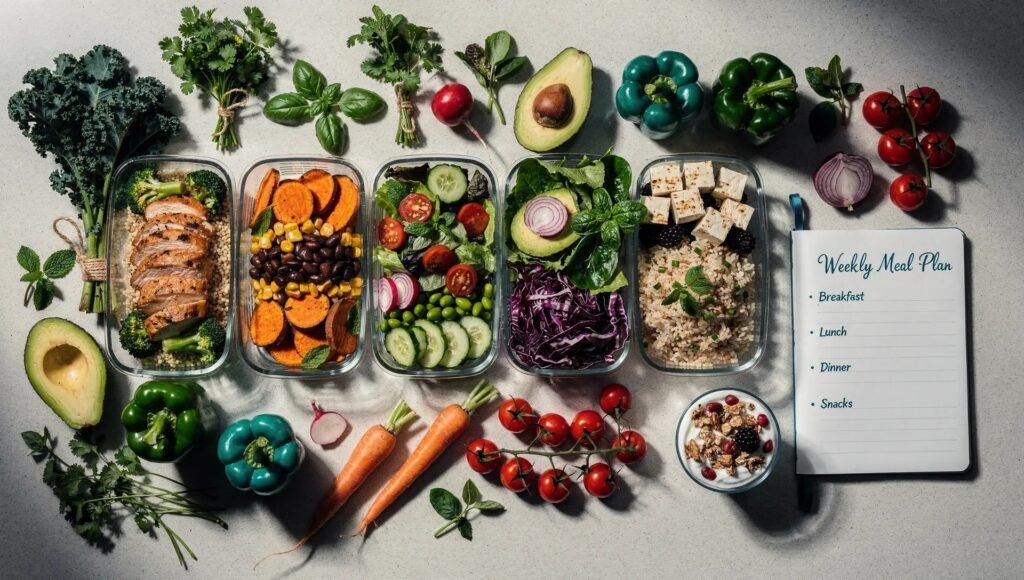
Can AI help me create a meal plan for the week
It’s Sunday. You’re staring into the fridge, no plan, no groceries, and the week ahead looks like another $200 in takeout. What if you could get a full week of meals planned — matched to your diet, your budget, and what’s already in your kitchen — in about ten minutes? AI can help you create a meal plan for the week, and it’s one of the most practical, money-saving uses of the technology.
Can AI Help You Create a Meal Plan for the Week? The Method
The Master Prompt
Here’s the template that produces genuinely usable plans:
“Create a 7-day dinner meal plan for [2 adults + 1 child]. Dietary needs: [high-protein / vegetarian / dairy-free]. Budget: [$150/week]. Each meal under 30 minutes on weeknights. Include: the meal, brief recipe or method, estimated cost per meal, and a consolidated grocery list organized by store section. Use overlapping ingredients to minimize waste.”
The magic phrases: consolidated grocery list (saves the second trip), overlapping ingredients (kills waste), time constraints (keeps it realistic).
Why This Works So Well
- Constraint satisfaction is AI’s home turf. Diet + budget + time + preferences + what’s in your fridge = exactly the kind of multi-variable puzzle AI solves instantly.
- Waste reduction: ask AI to design around ingredients you already have: “I have chicken thighs, rice, spinach, and coconut milk. Build 3 dinners around these, then a grocery list for the rest of the week.”
- Variety without decision fatigue: “We’ve had Italian twice this week — give me ideas from other cuisines with similar prep time.”
- Prep-day planning: “Which components can I batch-cook on Sunday to make weeknight dinners 15 minutes?”
Iterate Like a Human Would
The first plan is a draft. Refine it conversationally: “Swap Wednesday — the kids hate fish.” “Make Friday vegetarian.” “That recipe looks complicated; simplify it.” Three rounds of iteration produce a plan you’ll actually follow. The plan you follow beats the perfect plan you abandon.
Specialized Approaches
- Weight loss / fitness: “7-day high-protein meal plan, ~1800 calories/day, 5 meals, simple prep. Include macros per day.” Pair with an AI workout plan for the full system. (AI isn’t a dietitian — verify with one for medical needs.)
- Family with picky eaters: “Meals with a deconstructable structure — base + toppings — so kids and adults eat the same food differently.” Taco bars, grain bowls, pasta stations.
- Budget extreme: “Feed 2 adults for $75/week. Pantry staples first, minimal meat, maximum nutrition.” AI is surprisingly good at budget-stretching.
- Learning to cook: ask for technique explanations with each recipe, and graduate to our AI cooking coach guide.
The Money Math
The average American household wastes ~$1,500/year on uneaten food. A planned week with overlapping ingredients and a single consolidated shopping trip attacks both waste and impulse buying. Families commonly report saving $100–$200/month — which means ten minutes of AI meal planning has an hourly value of roughly $600. Show me a better-paid ten minutes.
Limitations to Know
- Verify nutrition claims for medical diets (diabetes, kidney disease) with a professional — AI approximates.
- Prices vary: AI’s cost estimates are rough. Track your actual receipts for a month to calibrate.
- Seasonality: remind AI what’s in season for better prices and quality.
- Taste is yours: AI can’t know you hate cilantro unless you tell it. Build a “never include” list in your prompt.
AI Meal Planning: Frequently Asked Questions
Can AI handle complex dietary restrictions?
Yes — this is where it shines brightest. “Gluten-free, dairy-free, nut-free, high-protein, under $150/week” is exactly the kind of multi-constraint puzzle AI solves well. Be specific about every restriction and severity (preference vs. allergy — the AI should know the difference matters). For medical diets like diabetes or kidney disease, use AI for ideas but verify everything with your doctor or dietitian. And always double-check labels yourself — AI can’t read the package in your pantry. The FoodSafety.gov site has reliable guidance on allergen labeling and safe food handling.
How accurate are AI’s cost estimates for groceries?
Roughly right on structure, imprecise on specifics. AI knows that chicken thighs are cheaper than breasts and that buying in bulk saves money, but it doesn’t know your store’s prices this week. Use its estimates for budgeting direction, then track your actual receipts for a month to calibrate. Most families find the real savings come from the consolidated list (fewer impulse buys) and reduced waste — not from the AI’s price predictions.
What if my family hates the meals AI suggests?
Then the AI doesn’t know your family yet — teach it. After each week, give feedback: “The kids hated the lentil curry, loved the taco bowls, and Tuesday’s recipe took 50 minutes not 30.” Two or three rounds of this and the plans get dramatically better. Build a permanent “never include” list (cilantro, mushrooms, whatever) and paste it into every prompt. The plan you follow beats the perfect plan you abandon.
Can AI help with meal prep, not just meal planning?
Absolutely — and the combination is powerful. Ask: “I have 2 hours on Sunday. Design a prep session for this week’s plan: what to cook in what order, using 2 sheet pans and 1 pot.” The AI sequences tasks efficiently (start the grains, chop while they cook, roast while you assemble). Sunday prep turns weeknight cooking from a 45-minute ordeal into 15-minute assembly.
Does AI meal planning work for one person?
Yes, with a tweak: ask for plans built around ingredient overlap and batch cooking, since cooking for one generates the most waste. “Plan 5 dinners for one person maximizing leftover reuse — Monday’s roast chicken becomes Tuesday’s tacos and Wednesday’s soup.” Solo cooks who plan waste far less than solo cooks who wing it.
The Bottom Line on AI Meal Planning
Can AI help you create a meal plan for the week? Yes — it’s one of AI’s best household applications: constraint-based planning across diet, budget, time, and existing ingredients, with a consolidated grocery list, in about ten minutes. Use the master prompt, iterate conversationally, and build your “never include” list. The families who stick with it save $100–$200/month and eat better with less stress. Your Sunday fridge-stare is officially obsolete.
Pingback: How can AI help me declutter and organize my home