Colin Farrell’s Second Act: Sobriety, Two Sons and an $80 Million Career Rebuilt on Character Roles
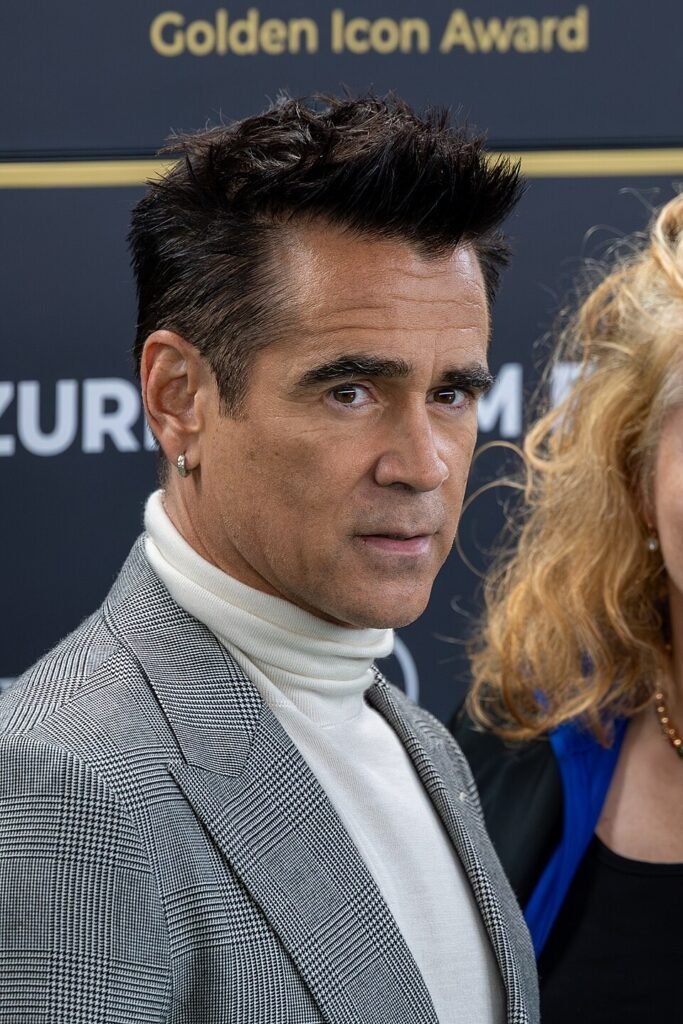
Colin Farrell’s Second Act: Sobriety, Two Sons and an $80 Million Career Rebuilt on Character Roles
Colin Farrell at a Glance
| Colin Farrell at a Glance | Details |
|---|---|
| Born | May 31, 1976, in Castleknock, Dublin, Ireland |
| Age | 50 |
| Height | 5 ft 10 in |
| Net Worth | $80 million (Celebrity Net Worth) |
| Weight | No reliable published figure |
| Partner | No publicly confirmed current partner |
| Children | Two sons: James Padraig (born September 12, 2003) and Henry Tadeusz (born October 7, 2009) |
| Parents | Eamon Farrell and Rita Farrell, née Monaghan |
| Nationality | Irish |
| No verified personal account — he maintains no official social media accounts |
A Dublin Boy, Son of a Footballer
Colin Farrell was born on May 31, 1976, in Castleknock, Dublin, Ireland. His father, Eamon Farrell, played professional football for Shamrock Rovers and later ran a health food business; his mother is Rita Farrell, née Monaghan. One correction opens the record: the bank behind this profile series files Farrell under the United Kingdom. He is Irish, born and raised in Dublin, and his table prints the nationality the record supports. He attended St. Brigid’s National School and Castleknock College, drifted through a spell in Australia as a young man, and came home to study acting at the Gaiety School of Acting in Dublin — which he left when television work arrived first.
His first screen work came in the Irish film Drinking Crude (1997) and the television drama Falling for a Dancer (1998), and he had earlier auditioned, unsuccessfully and by his own cheerful account, for the boy band Boyzone. The work that mattered arrived through Ballykissangel, the BBC drama set in rural Ireland, where he played Danny Byrne from 1998 to 1999. Irish and British audiences learned his face there. Hollywood learned it almost immediately after, and the speed of what followed — fame, money and excess arriving together in his early twenties — forms the first act of the story. Farrell himself tells it without self-pity: he had the talent, took the chances, and spent years spending the proceeds exactly as recklessly as the tabloids reported.
How Tigerland Announced Colin Farrell
2000 — Tigerland and the Hollywood rush
Joel Schumacher cast him as the lead in Tigerland (2000), a Vietnam-era drama shot fast and cheap, and Farrell’s performance announced a major talent. The rush followed: Minority Report (2002) opposite Tom Cruise, Phone Booth (2002), S.W.A.T. (2003), Daredevil (2003) as the villain Bullseye, and Alexander (2004), Oliver Stone’s epic in which he played Alexander the Great. The films made him one of the most bankable young actors alive and, by his own later account, one of the least disciplined. Miami Vice (2006) closed the first phase; during its production his struggles with addiction became impossible to hide, and he entered treatment at the end of 2005.
2008 — In Bruges and the rebuild
Sobriety changed the casting. Martin McDonagh wrote In Bruges (2008) around him — a hitman hiding in Belgium, funny and wrecked at once — opposite Brendan Gleeson’s net worth profile, and the performance won Farrell a Golden Globe and restarted his career on new terms: smaller films, better directors, characters with damage in them. The Way Back (2010), Fright Night (2011), Seven Psychopaths (2012) with McDonagh again, Saving Mr. Banks (2013) and The Lobster (2015), which earned him another Golden Globe nomination, built the second filmography — the one critics now treat as the real one.
2015 — True Detective, Sacred Deer and the character-actor decade
The rebuild deepened through the 2010s. He played a haunted detective in the second season of True Detective (2015), a gentleman thief in Fantastic Beasts and Where to Find Them (2016), a surgeon courting doom in The Killing of a Sacred Deer (2017) and a Civil War-era seducer in The Beguiled (2017), the last two for directors — Yorgos Lanthimos and Sofia Coppola — who cast him for unease rather than charm. Widows (2018), Dumbo (2019), After Yang (2021) and Thirteen Lives (2022), where he played the cave diver John Volanthen, kept the pattern: ensemble pieces, auteur directors, performances that reviewers singled out. The industry now described him the way it describes its most trusted instruments.
2022 — The Banshees of Inisherin and the peak
McDonagh’s The Banshees of Inisherin (2022) gave him Pádraig, a kind man bewildered by a friend’s rejection, and the performance won him the Volpi Cup at Venice, a Golden Globe, and his first Academy Award nomination. The same year he played the Penguin in The Batman (2022), buried under prosthetics and stealing every scene; reports put his fee for that film at $10 million, an earnings figure the fortune section keeps in its place. The Penguin series (2024) extended the role across eight episodes and brought him the Golden Globe and the Screen Actors Guild Award for the performance — the industry formally certifying what audiences had already decided. Ballad of a Small Player (2025), for director Edward Berger, and A Big Bold Beautiful Journey kept the dramatic run going, and at 50 he works at the rate of an actor half his age, choosing directors over franchises.
The Penguin deserves a paragraph of its own in any account of the second act, because the role inverts his first fame completely. The young Farrell sold beauty and danger; the Penguin sells neither — a waddling, scarred, middle-ranking gangster whom Farrell builds from voice, gait and appetite until the character turns tragic. Critics compared the transformation to the great prosthetic performances of the past, and the streaming audience made the series one of its platform’s biggest hits of 2024. A character part in a comic-book property became the peak of a serious career: that sentence summarizes the whole rebuild.
Two Sons, Sobriety and a Life Never Married
Farrell has never married. A 2001 ceremony in Tahiti with the actor Amelia Warner attracted wide reporting, but the ceremony carried no legal force, and Farrell states the position plainly: he has no wife. A fabricated online biography that assigns him a wife and five sons circulates stubbornly; the verified record corrects it here — no wife, and two sons. His most recent long-term relationship, with Kelly McNamara, ran about five years from 2017 and reportedly ended in March 2023; no new partner has entered the public record since, and the table prints exactly that.
His public energy, when he spends it, goes to causes tied to his family. In October 2024 he pushed his friend Emma Fogarty — who lives with the skin condition epidermolysis bullosa — in her wheelchair across the final stretch of the Dublin Marathon, completing the race alongside her and helping raise a large sum for the charity Debra Ireland. Photographs of the finish circled the world, and Farrell deflected the attention toward Fogarty and the condition, in keeping with the foundation’s purpose.
His sons anchor the private life. James Padraig, born September 12, 2003, whose mother is Kim Bordenave, lives with Angelman syndrome, a genetic condition affecting development and speech; Farrell speaks about him with open pride and, in August 2024, launched the Colin Farrell Foundation to support families of children with intellectual disabilities as those children age out of school-based services. Henry Tadeusz, born October 7, 2009, whose mother is the actor Alicja Bachleda-Curuś, completes the family. Farrell achieved sobriety in 2006 and discusses it as the hinge of his life — the career, the fatherhood and the fortune all date their stability from that year. He keeps no official social media accounts; aggregator handles that use his name, such as @farrellgram, do not belong to him, and this profile prints none as his.
The Banshees year also demonstrated his range’s commercial side in a way worth recording. In a single calendar stretch he headlined a tiny Irish two-hander, a Thai cave-rescue ensemble, a science-fiction chamber piece and a superhero blockbuster — four productions at four budget levels, each built partly on his name. Studios read that spread as insurance: Farrell now functions simultaneously as prestige casting and as box-office ballast, and actors who hold both positions at 50 can choose their work rather than chase it. The quote, the reviews and the streaming numbers all say the same thing from different directions.
Character Roles, an Oscar Nod and an $80 Million Fortune
Celebrity Net Worth estimates Colin Farrell’s net worth at $80 million, and this profile attributes the figure to that source at every mention. No competing total from another named reputable publication appears in the record. The reported $10 million fee for The Batman counts as earnings for a single production — a very large paycheck, printed as a paycheck — and not as a measure of his wealth in itself.
The accumulation runs in two distinct phases. The first phase paid star salaries at the peak of the studio era: the run from Minority Report through Alexander and Miami Vice placed him in the top bracket of young leading men, and those years built the fortune’s foundation even as his personal life burned through its share. The second phase pays less per film on paper and more per year in practice — steady leading roles in prestige productions, the Penguin franchise work for DC, and the awards-season value that keeps his quote high at 50. No reliable published inventory of his property exists in the record, so this profile states the position plainly: the verified elements are the salary history and the attributed $80 million estimate.
He divides his base between Los Angeles, where the industry and much of his sons’ schooling sit, and Dublin, where his family and his foundation’s work center. The geography mirrors the career: Hollywood pays him, Ireland claims him, and he has stopped pretending the two loyalties conflict. Agents who handle his deals describe a performer whose quote survived his reinvention intact — a rare outcome, since the industry usually discounts a rebuilt star. The awards did that work: a quote follows the last three credits, and his last decade’s credits read like a festival program.
The Star Whose Second Act Outshines the First
Farrell’s career divides cleanly at 2006, and the second half outshines the first: the Golden Globes, the Venice Volpi Cup, the Oscar nomination and a run of collaborations with the directors — McDonagh above all — who write toward his particular mix of charm and damage. Hollywood history usually files such stories under wasted promise; his refused the filing.
At 50, he works constantly, raises two sons, runs a foundation in James’s honor, and holds an $80 million fortune by Celebrity Net Worth’s measure. Dublin produced him, fame nearly finished him, and sobriety handed him the longer, better career — the one still running. Casting directors now reach for him when a script needs a man who has visibly lived, and the face that once sold posters now sells truth; the market repriced him upward for the exchange, which is the whole second act in a single sentence.