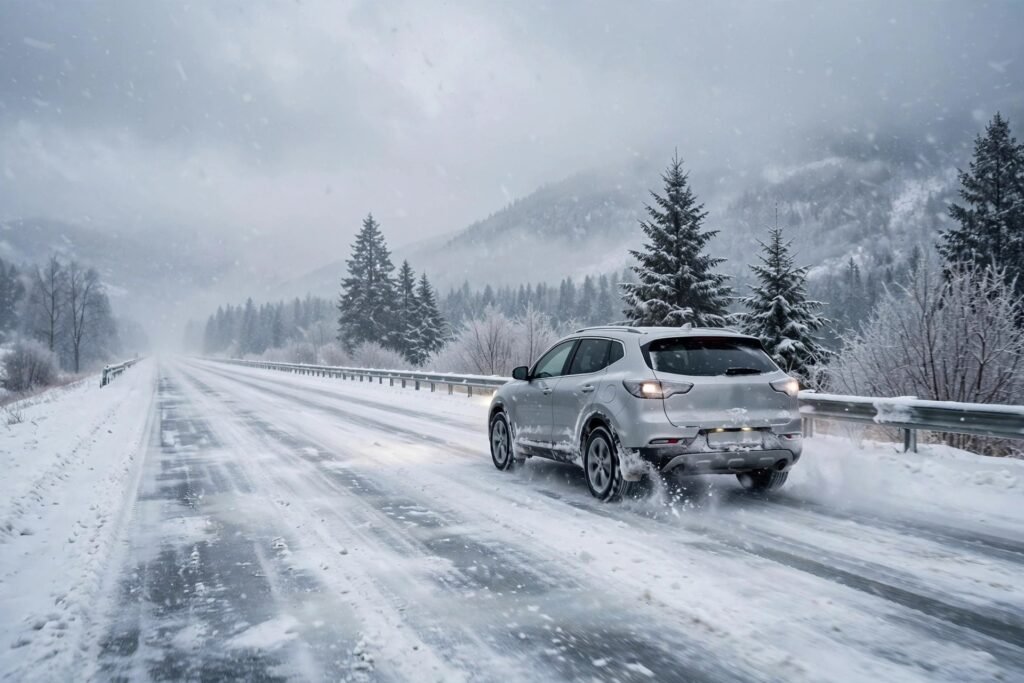
How to Drive Safely on Icy Highways: Winter Survival Guide
Every winter, icy highways turn routine commutes into some of the most dangerous driving in America. The Federal Highway Administration reports over 1,300 deaths and 116,800 injuries annually in crashes on snowy, slushy, or icy pavement — and icy bridges and overpasses, which freeze before surface roads, are the scene of the worst pileups. Most of these crashes share a root cause: drivers treating ice like wet pavement, just a bit more slippery.
Ice demands a fundamentally different driving method. This guide covers the physics of why cars lose grip, the winter preparation that prevents emergencies, the exact techniques for driving on ice, and what to do when the car starts sliding — because the wrong instinct in a skid is what turns a scare into a crash.
Why Ice Defeats Normal Driving
A tire grips the road through friction, and on dry pavement there is an enormous reserve of it — you can brake hard, swerve, and accelerate simultaneously. On ice, available friction drops to roughly one-tenth of dry levels. That changes everything: stopping distances multiply by up to ten times, and any sudden input — braking, steering, accelerating — can exceed the available grip instantly.
Black ice is the worst case because it is invisible: a thin, transparent glaze that looks like wet pavement, forming when temperatures hover around freezing, especially on bridges, overpasses, shaded curves, and anywhere meltwater refreezes overnight. If the road looks wet and the temperature is near 32°F, drive as if it is ice — because it probably is in patches.
Know Your Vehicle’s Systems
Anti-lock brakes (ABS), electronic stability control (ESC), and traction control all help on ice — but none repeal physics. ABS prevents wheel lockup so you can steer while braking hard; ESC selectively brakes individual wheels to counter skids. Both are standard on modern cars and both save lives. But all-wheel drive deserves a blunt correction: AWD helps you go on ice, not stop or turn. The deadliest winter-driving myth is “I have AWD, I’m fine” — every car has all-wheel braking, and ice does not care about your drivetrain.
Before You Go: Winter Preparation
Tires are everything. The single biggest safety upgrade is winter tires — their rubber compounds stay pliable below 45°F where all-seasons harden, and their tread patterns bite into snow and ice. Tests consistently show winter tires cutting stopping distances by 30-50 percent on ice versus all-seasons. Check tread depth (the quarter test: 4/32″ minimum for winter) and run pressures a touch higher in cold — tires lose about 1 PSI per 10°F drop.
The winter kit. Blankets, extra warm layers, phone charger, flashlight, shovel, sand or kitty litter for traction, jumper cables, water and snacks, and a full tank of gas (never let it drop below half in winter — you may need to idle for heat if stranded). Keep an ice scraper that actually works and de-icer spray.
See and be seen. Clear all snow and ice from the car — not a porthole in the windshield. Snow blowing off your roof blinds drivers behind you (and is illegal in a growing number of states). Top off washer fluid with winter-rated fluid; summer fluid freezes on contact in January.
General vehicle readiness matters year-round, and the fundamentals in our guide to basic car maintenance — fluids, battery, wipers — are doubly important before winter. If you are heading into unfamiliar winter territory in a rental, also review avoiding car rental fees abroad — or domestically — since winter rentals often hide ski-rack and insurance upsells.
Techniques for Driving on Ice
Slow down — more than feels necessary. The safe speed on ice is often 30-45 mph on highways where you would normally do 65-70. Speed does not just lengthen stopping distance; it exponentially increases the energy of any crash. If traffic is passing you, let it. Arriving late beats not arriving.
Multiply following distance. The two-second rule becomes eight to ten seconds on ice. At 40 mph on ice, stopping can take 400+ feet — more than a football field. Watch the car ahead for brake lights as your early-warning system.
Be boringly smooth. Every input — throttle, brake, steering — should be gradual. Accelerate gently from stops (spinning wheels polish ice slicker). Brake early and lightly, well before curves and intersections. Steer with small, progressive movements; jerking the wheel is how skids start.
Handle hills and bridges with respect. Bridges freeze first — slow before the bridge, not on it. On downhills, descend in a lower gear and avoid braking mid-slope. On uphills, build gentle momentum before the climb and do not stop halfway if avoidable.
Use headlights, not high beams. Daytime running lights do not illuminate taillights on many cars — manually switch headlights on in winter precipitation so you are visible from behind.
When the Car Starts Sliding: Skid Recovery
Despite everything, it can happen. What you do in the next two seconds determines the outcome — and your instincts will be wrong, so rehearse this mentally now:
Rear-wheel skid (back end slides out — oversteer). This is the classic fishtail. Take your foot off both pedals — do not brake — and steer gently into the skid (if the rear slides left, steer left). Look where you want to go, not at what you fear hitting; your hands follow your eyes. As the car straightens, straighten the wheel — overcorrecting starts a worse skid the other way.
Front-wheel skid (car plows straight despite steering — understeer). Ease off the gas, do not add more steering lock (turned wheels that are not gripping just slide), and wait for grip to return as speed bleeds off. Then steer gently.
ABS activation. If you must brake hard, press firmly and hold — the pulsing pedal and grinding noise are normal. Do not pump ABS brakes; pumping defeats the system. Steer around the obstacle while braking.
The single most important preparation for skids is an empty parking lot. After the first snowfall, spend 20 minutes in a vacant lot deliberately inducing small slides at low speed and practicing recovery. It is the cheapest advanced driving course in existence, and it converts panic into procedure.
If You Get Stranded or Crash
Stay with the vehicle — it is shelter and it is visible. Run the engine 10-15 minutes per hour for heat (crack a downwind window slightly to prevent carbon monoxide buildup, and clear snow from the exhaust pipe). Tie something bright to the antenna, turn on hazard lights, and call for help. If a crash is unavoidable, aim for the softest, cheapest thing — a snowbank beats a guardrail beats another car — and never swerve into oncoming traffic to avoid a lesser obstacle.
NHTSA’s winter driving safety hub has vehicle-specific guidance and recall information, and AAA’s winter driving resources cover emergency kit checklists and what to do when stranded.
Conclusion
Safe winter highway driving is 90 percent preparation and restraint: winter tires, a stocked emergency kit, speeds far below the limit, vast following distances, and smooth inputs. The remaining 10 percent is skid recovery — steer into the skid, off the pedals, eyes where you want to go — rehearsed in a parking lot before you need it on a bridge. Ice does not forgive hurry. Give it respect, and it will give you the road home.
Frequently Asked Questions
Are winter tires really necessary, or are all-seasons enough?
Winter tires are the single biggest safety upgrade for icy driving — their cold-weather compounds and tread patterns cut stopping distances 30-50% versus all-seasons on ice. All-seasons harden below about 45°F and lose grip progressively.
What should I do in a skid on ice?
Take your foot off both pedals, steer gently into the skid (rear sliding left → steer left), look where you want to go, and straighten the wheel as the car recovers. Do not brake during a rear-wheel skid.
Does all-wheel drive help on ice?
Only with acceleration. AWD does not help you stop or turn on ice — every vehicle has all-wheel braking. Winter tires matter far more than drivetrain for ice safety.
How much should I slow down on icy highways?
Often to 30-45 mph where you would normally drive 65-70, with 8-10 seconds of following distance. Stopping distances on ice can be up to ten times longer than on dry pavement.
What is black ice and where does it form?
Black ice is a thin, transparent glaze that looks like wet pavement. It forms most readily on bridges, overpasses, shaded areas, and anywhere near freezing temperatures — treat any “wet-looking” road near 32°F as potentially icy.