How to Pick the Right Blush Color for Fair Skin (Guide)
Blush is having a renaissance — but for fair skin, it remains the trickiest product in the bag. The wrong shade turns clownish, muddy, or invisible within an hour. Too dark and you look sunburned; too bright and you look theatrical; too brown and you look bruised. Yet the right blush on fair skin is transformative: it brings life, dimension, and health to a complexion that can otherwise look flat. Finding it is a matter of undertone, depth, and formula — all learnable.
Here is how to pick the right blush color for fair skin: the undertone rules, the specific shades that work, formulas ranked for fair complexions, and the application technique that keeps blush natural instead of stripey.
Undertone First, Always
Fair skin’s undertone determines everything. Cool undertones (pinkish skin, blue-purple veins, silver jewelry flatters) want cool blushes: soft pinks, rose, berry-pink, cool mauve. These harmonize with the skin’s natural pink rather than fighting it. Warm undertones (peachy or golden fair skin, green veins, gold jewelry flatters) want warm blushes: peach, apricot, warm coral, soft terracotta. These echo the skin’s warmth. Neutral undertones can wear both — dusty rose and neutral peach are the safest starting points.
The white-paper test from color theory applies here exactly as it does for lipstick: hold white paper to your bare face in daylight. Rosy beside white means cool; golden means warm. Get this right and half the blush counter eliminates itself.
Shades That Work on Fair Skin
The universal winners
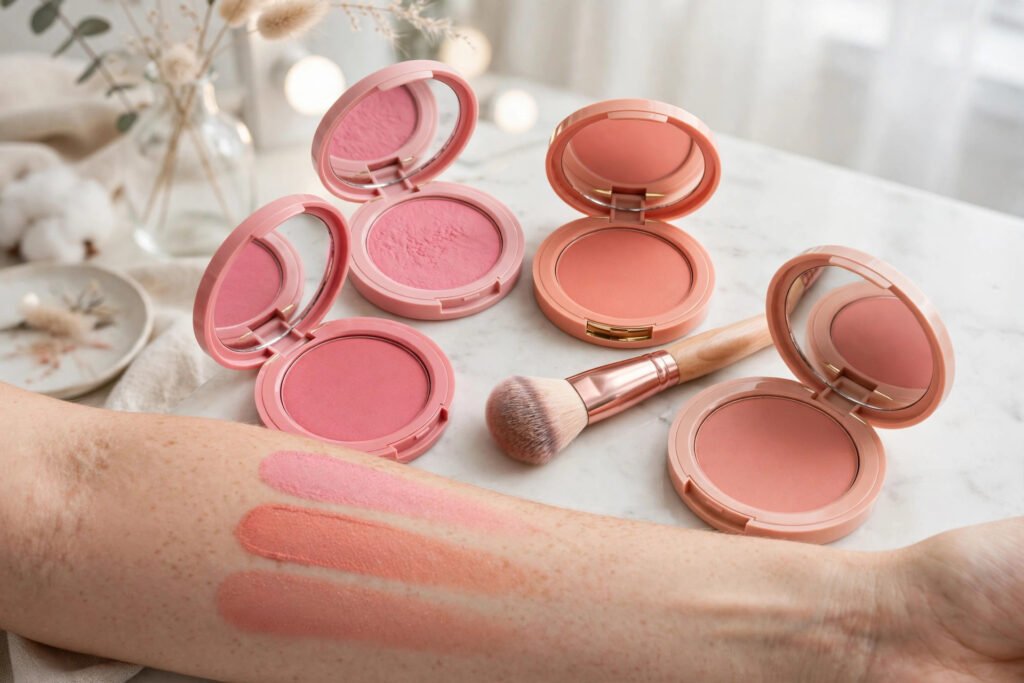
Soft pink — the fair-skin default. It mimics a natural flush, suits cool and neutral undertones, and is nearly impossible to overdo in a sheer formula. Dusty rose — slightly deeper, adds sophistication, works across undertones. Peach — the warm-undertone hero, brightening without the harshness of true orange. These three shades cover 90 percent of fair-skinned wearers.
Shades to approach carefully
Bright coral and vivid orange overwhelm fair skin unless applied with an extremely light hand — they can work on warm fair skin in sheer formulas but punish heavy application. Deep berry and plum read dramatic and gothic on fair skin; beautiful for evening, too much for day. Brown-based “contour blushes” often turn muddy on fair skin — if you want warmth, peach does it better. And anything described as “universal” deserves skepticism — on fair skin, universal usually means “designed for medium skin.”
Formula Matters More Than You Think
Cream and liquid blushes are the fair-skin MVPs: they melt into skin, sheers out effortlessly, and create the lit-from-within flush that powder struggles to replicate. They are also more forgiving — over-application blends away. Powder blushes work fine but demand a lighter hand and a fluffy brush; highly pigmented powders are the top cause of clown-cheek incidents. Tint and stain formulas offer the most natural, long-wearing flush but the least forgiveness — apply sparingly and blend immediately.
Finish matters too: matte blushes look most natural for daytime; subtle shimmer adds glow for evening but emphasizes texture and pores — fair skin shows texture readily, so keep shimmer finely milled and minimal.
Application: The Natural Flush Technique
Smile lightly and apply to the apples of the cheeks — then blend upward toward the temples, not downward (downward drag ages the face). The biggest mistake: applying too much at once. Build in sheer layers — you can always add, but removing overdone blush disturbs the foundation underneath. For the most natural effect, apply blush before setting powder (cream blush) or use the “blush draping” method sparingly.
Placement changes the effect: apples-only reads youthful and fresh; swept along the cheekbones reads sculpted; a touch across the nose bridge reads sun-kissed (use sparingly — it is easy to overdo). Match placement to the occasion, and step back from the mirror — blush always looks stronger up close than at conversation distance.
Budget and Building Your Collection
You do not need twelve blushes. Two well-chosen shades — a daily soft pink or peach and one deeper option for evening — cover everything. Drugstore cream blushes have closed the quality gap dramatically; high pigment at low prices means the look stylish on a tight budget approach works beautifully for blush. Fold the occasional addition into how much you budget for monthly self-care rather than impulse-buying every launch.
For ingredient-conscious shoppers, the FDA’s cosmetics information covers what is regulated in color cosmetics — and the American Academy of Dermatology recommends non-comedogenic formulas for breakout-prone skin, a label worth checking on any blush.
Blush Techniques Worth Trying on Fair Skin
Blush draping — sweeping blush from the apples up along the cheekbones toward the temples in place of contour — flatters fair skin beautifully when done with a light hand and a sheer formula; the monochrome color lifts the face without the harshness contour can bring to pale complexions. The “sunburnt” blush trend (blush swept across the nose bridge) suits fair skin’s natural flush response but demands restraint — a whisper reads sun-kissed, a stripe reads costume.
Layering formulas creates the longest-wearing flush: cream blush first, set lightly with a matching powder blush on top. The cream provides the natural melded color; the powder locks it in for all-day wear. And the underpainting technique — blush applied before foundation, then foundation sheered over it — creates the most natural flush of all, because the color glows through rather than sitting on top. It takes practice to dose correctly (too much blush under foundation looks muddy), but the result is the “no-makeup” flush that fair skin wears best.
Fixing mistakes
Too much blush? Do not wipe it off — press a clean damp sponge over it to sheer it out, or dust translucent powder over the top to mute it. Wrong undertone showing orange? Layer a cooler pink blush over it to correct rather than starting over. Blush mistakes are almost always fixable without removing your base; the panic-removal causes more damage than the original error.
Conclusion
The right blush for fair skin starts with undertone — cool skin wants soft pinks and roses, warm skin wants peach and apricot, neutral skin starts with dusty rose. Choose cream or liquid formulas for the most forgiving application, build color in sheer layers on the apples blended upward, and keep the collection tight: two great shades beat twelve mediocre ones. Get these right and blush stops being a risk — it becomes the five-second step that makes you look alive.
Frequently Asked Questions
What blush color is best for very fair skin?
Soft pink or sheer peach, depending on undertone — cool fair skin suits pink and rose; warm fair skin suits peach and apricot. Sheer formulas are the safest starting point.
Why does blush look orange on me?
Usually a warm-toned blush on cool-undertone skin, or too much product. Switch to a cooler pink or rose, apply less, and blend more — the orange cast is almost always a shade or quantity issue, not a skin issue.
Cream or powder blush for fair skin?
Cream or liquid for most fair-skinned wearers — they blend more forgivingly and look more natural. Powder works with a light hand and fluffy brush but punishes over-application.
Where exactly should I apply blush?
Smile, apply to the apples, blend upward toward the temples. Avoid applying below the cheekbone line or too close to the nose — both placements age the face and look unnatural.