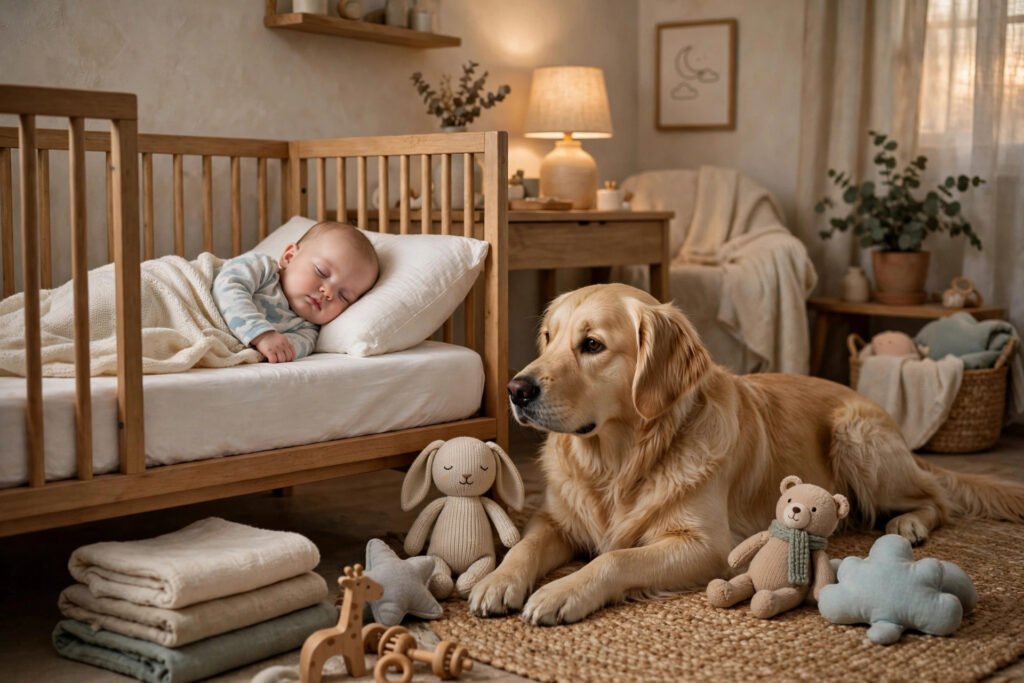
How to Prepare Your Pet for a New Baby (2026 Guide)
The nursery is painted, the crib is assembled, and your dog keeps sniffing the tiny clothes with deep suspicion. Or your cat has claimed the bassinet as a heated bed and sees no reason to renegotiate. Bringing a baby home is one of the biggest disruptions a pet will ever experience — new sounds, new smells, new routines, and suddenly they are not the baby anymore. Most pets adjust beautifully. The ones that do not usually suffered from lack of preparation, not lack of love.
Here is how to prepare your pet for a new baby: the months-before training that prevents problems, the scent and sound introductions that defuse the shock, setting up baby zones and pet zones, and the critical first weeks after the baby arrives.
Start Training Months Before the Due Date
Reinforce the basics now
A dog that jumps on visitors, pulls on leash, or guards the couch will do all of it around a baby — with higher stakes. Use the pregnancy months to proof the fundamentals: sit-stay with distractions, calm greetings, “place” or “go to bed” on cue, and loose-leash walking (you will be pushing a stroller). These are not baby-specific skills; they are life skills that become safety skills.
Teach baby-relevant manners
Practice stroller walks with the empty stroller so the dog learns the new formation before the baby is in it. Train a rock-solid “leave it” — it will protect everything from dropped pacifiers to diaper contents. Get the dog comfortable with handling: gentle ear touches, paw handling, and being briefly restrained, rewarded calmly — because babies grab, and a dog that has been desensitized to clumsy handling reacts with patience instead of panic.
Adjust routines gradually
If the dog’s walk schedule, feeding times, or sleeping arrangements will change after the baby arrives, change them now — months early. A dog whose routine collapses the week the baby arrives connects the disruption to the baby. Shift gradually and the new normal is just normal by the time the baby comes home.
Scent, Sound, and Space Introductions
Scent familiarization
Before the baby comes home, introduce baby smells: lotions, shampoos, diaper cream. Let the pet sniff baby laundry (after the hospital, send home a worn onesie or blanket for the pet to investigate before the baby arrives — the classic trick works because scent is a dog’s primary information channel). Reward calm investigation; do not force interaction.
Sound desensitization
Babies are loud and unpredictable — crying, squealing, electronic toys. Play recordings of baby sounds at low volume during pleasant activities (meals, play), gradually increasing over weeks. A dog that has heard crying hundreds of times before the real thing stays dramatically calmer than one hearing it for the first time at 2 a.m. with exhausted parents.
Set up zones before the baby
Install baby gates, set up the nursery, and establish pet-free zones weeks early so the pet learns the new boundaries without associating them with the baby’s arrival. Every pet needs a sanctuary — a room, crate, or bed that is theirs alone, where they can retreat from baby chaos without being followed. For cats, ensure vertical escape routes: a stressed cat that can go up is a cat that does not lash out.
The Homecoming: First Introductions
When you come home from the hospital, greet the pet first — alone, calmly, without the baby. Let them burn off the excitement of your return. Then introduce the baby in a controlled, boring way: the dog on leash, the baby held securely, brief sniffing allowed, calm behavior rewarded. Keep it short and undramatic. The goal is “this is normal,” not a Hallmark moment.
For cats, the introduction is even lower-key: let the cat approach the baby’s scent and space on their own terms. Never force proximity. Supervise all baby-pet interactions without exception — not because your pet is dangerous, but because babies are unpredictable and even a startled gentle pet can scratch or nip reflexively.
The First Weeks: Managing the New Normal
Protect the pet’s needs
Sleep-deprived parents inevitably shortchange the pet — shorter walks, less play, less attention. This is when behavior problems bloom. Protect non-negotiables: the dog still gets real exercise (hire a walker if needed — it is cheaper than a behaviorist later, and an honest look at whether a pet fits a busy lifestyle should have predicted this need), the cat still gets play sessions, feeding stays on schedule. A pet whose needs are met tolerates disruption; a neglected pet acts out.
Supervision rules that never bend
Never leave a baby and pet together unsupervised — not for a second, not “just to grab a bottle.” Most bites to children happen with familiar, “gentle” family pets during unsupervised moments — a pattern the CDC’s healthy pets guidance highlights in its family safety recommendations. As the baby becomes mobile, the risk profile changes: crawling babies corner pets, pull tails, and grab faces. Teach children early to respect the pet’s space, and always give the pet an escape route.
Watch for stress signals
Decreased appetite, hiding, excessive grooming, house-soiling, or new aggression signal a pet struggling to adjust — not a “bad” pet. These are treatable with routine restoration, more exercise, and sometimes professional help. The ASPCA’s guide to dogs and babies covers the behavioral warning signs that warrant a trainer or veterinary behaviorist.
Special Situations
Resource guarding
Any history of guarding food, toys, or space must be addressed with a professional before the baby arrives — this is a safety issue, not a training preference. Do not attempt to “test” a guarding dog around baby items yourself.
Cats and cribs
Cats seek warm, enclosed sleeping spots, and a crib qualifies. Use a crib tent or keep the nursery door closed — always. The old myth about cats “stealing babies’ breath” is nonsense, but a cat sleeping on an infant’s face is a genuine suffocation risk. Manage it with barriers, not fear.
When to consider rehoming (rarely)
Genuine danger — a dog with a bite history toward children, unmanageable aggression despite professional intervention — is the only reason to rehome, and it is heartbreakingly rare. The vast majority of “we have to get rid of the dog” situations are solvable with training and management. Reach out to trainers and behaviorists before reaching conclusions; most problems that feel permanent at 3 a.m. with a newborn are fixable in daylight.
Conclusion
Preparing your pet for a new baby means starting months early: proofing obedience, desensitizing to baby sounds and smells, setting up zones and routines before the disruption, and managing the homecoming as a calm non-event. After the baby arrives, protect the pet’s exercise and routine, supervise every interaction without exception, and watch for stress signals early. Do the preparation and your pet does not lose their place in the family — they gain a small human to grow up alongside. (And when the family eventually travels together, planning pet-friendly hotels that do not charge huge fees keeps baby-and-pet trips affordable.)
Frequently Asked Questions
When should I start preparing my dog for a baby?
Three to six months before the due date. Training, desensitization, and routine changes all need weeks to take hold — starting early means the baby arrives into an already-adjusted household.
Is it safe to have cats around newborns?
Yes, with basic management: keep cats out of the crib (closed door or crib tent), supervise interactions, and maintain the cat’s routine. The “cat stealing breath” myth is folklore; the real risk is a cat sleeping on the infant, which barriers prevent.
Should I let my dog sniff the baby?
Yes — brief, calm, supervised sniffing is good. It gives the dog information and demystifies the baby. Keep sessions short, reward calm behavior, and do not force prolonged contact.
My dog is jealous of the baby. What do I do?
Maintain the dog’s exercise and one-on-one attention, reward calm behavior around the baby, and avoid punishing attention-seeking — it increases anxiety. Most “jealousy” is really routine disruption, and it resolves as the new normal sets in.