How to Stop Cats From Scratching Leather Couches (Guide)
You bought the beautiful leather couch. Your cat looked at it, looked at you, and claimed it as the world’s most expensive scratching post. Cat scratching is not misbehavior — it is a biological need as fundamental as eating. Cats scratch to maintain claw health, stretch their bodies, and mark territory with scent glands in their paws. You cannot train the instinct out. You can only redirect it somewhere that is not your furniture.
Here is how to stop cats from scratching leather couches: why they target leather specifically, the redirection strategy that actually works, deterrents for the couch itself, and the claw-maintenance routine that reduces the urge in the first place.
Why Cats Love Leather Couches
Leather hits every feline scratching preference at once: it is tall and vertical (perfect for the full-body stretch), stable and heavy (it does not wobble like a cheap scratcher), and texturally satisfying (claws sink in with ideal resistance). Worse, once scratched, leather holds the cat’s scent markings, which invite repeat visits — the couch literally smells like “the scratching place” to your cat. Understanding this is key: you are competing against a perfect product, so your alternative has to be genuinely better, not just present.
The Redirection Strategy: Make the Post Win
Get the right scratching post
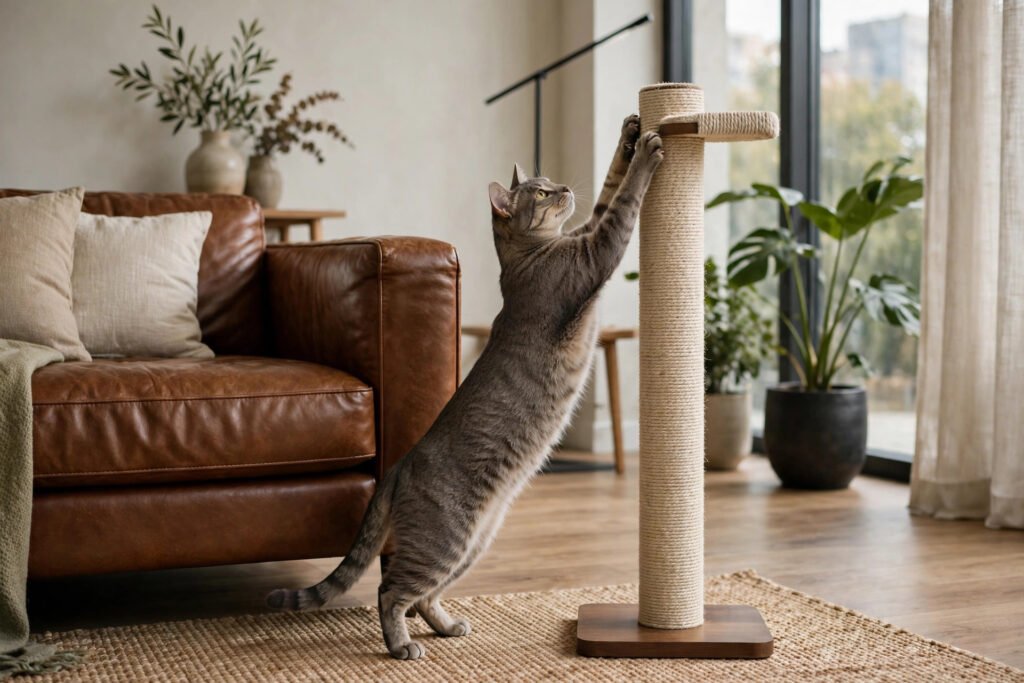
Most scratching posts fail because they are too short, too wobbly, or the wrong texture. A good post is tall enough for a full vertical stretch (at least 28 to 32 inches for an average cat), rock-solid stable (wall-mounted or heavy-based — if it wobbles, the cat will return to the couch), and wrapped in sisal fabric (not rope — fabric gives the satisfying shred most cats prefer). Offer variety: a vertical post plus a horizontal cardboard scratcher covers the two main scratching styles. Place the new post directly beside the couch’s favorite scratching spot — location matters more than any other factor.
Train the switch with rewards
Reward every use of the post enthusiastically — treats, praise, play. Sprinkle catnip or silvervine on the post to build initial interest. Play with a wand toy around the post so the cat interacts with it naturally. When you catch the cat heading for the couch, redirect calmly to the post and reward. Never punish scratching — punishment creates anxiety (which increases scratching) and damages your relationship. The goal is making the post the rewarding choice, not making the couch the scary one.
One post per cat, plus one
In multi-cat homes, a single post creates competition. The rule of thumb: one scratching surface per cat plus one extra, spread across the rooms where cats spend time. A post in the living room does nothing for the cat that scratches the bedroom furniture. (Cats also scratch car upholstery on rides — these tips for keeping your car clean with kids and pets cover carrier setups that protect seats.)
Protecting the Couch During Transition
Physical barriers
While retraining, make the couch temporarily unappealing. Double-sided sticky tape products designed for furniture (like StickyPaws) are the most effective deterrent — cats hate the tacky texture, and it does not damage leather when removed properly. Clear vinyl furniture protectors or throws cover the scratched zones. Aluminum foil works short-term but looks terrible; use it only as a stopgap.
Scent deterrents
Citrus-scented sprays marketed as cat deterrents have mixed results — some cats ignore them entirely. Feliway pheromone diffusers near the couch can reduce territorial scratching specifically, an approach International Cat Care’s scratching advice supports for marking-related scratching, since they signal “this area is already marked and safe.” Results vary by cat, but pheromones have solid behavioral science behind them and no downsides.
Repair the existing damage
Clean scratched areas to remove the scent markings that invite repeat scratching, and consider a leather repair kit for surface marks — deep punctures may need professional repair. Removing the visual and scent cues of “established scratching territory” meaningfully helps the retraining stick.
Claw Maintenance: Reduce the Urge
Regular nail trims — every two to three weeks — blunt the damage potential and reduce the frequency of intense scratching sessions. Trim only the sharp tip, avoiding the pink quick. For cats that will not tolerate trims, soft nail caps (like Soft Paws) glued over the claws prevent furniture damage entirely; they fall off naturally in four to six weeks and most cats adjust within days. They are an excellent bridge during retraining.
Provide appropriate claw conditioning everywhere the cat spends time — the easier it is to scratch the right thing, the less the couch gets used. And keep the cat’s overall life enriched: bored, understimulated cats scratch more destructively. The same winter-boredom principles behind keeping indoor cats active through long winters apply year-round — a well-exercised cat with hunting outlets is a gentler cat on furniture.
What Not to Do
Never declaw. Declawing is not nail removal — it is amputation of the last bone of each toe, causing chronic pain, litter-box avoidance, and increased biting in a large share of cats. It is banned or restricted in many places and condemned by every major veterinary organization, including the ASPCA. Spray bottles, yelling, and physical punishment do not teach the cat where to scratch — they teach the cat to scratch when you are not watching. And do not give up after a week: retraining takes two to six weeks of consistency, but it works for the vast majority of cats.
Multi-Cat Households: Scratching Competition
In homes with multiple cats, scratching intensifies — it is territorial communication, and more cats means more messages to send. Each cat needs their own scratching surfaces in their preferred territories; a single post for three cats creates competition that drives everyone back to the couch. Place posts near each cat’s favorite resting spots, since cats typically scratch right after waking up as part of their stretch routine.
Watch for inter-cat tension expressed through scratching: a cat that suddenly starts scratching furniture after a new cat arrives is often marking insecurity, not being spiteful. Feliway Friends diffusers, additional vertical territory, and ensuring each cat has safe retreat spaces address the root cause. Punishing the scratching in this scenario increases the anxiety driving it — always treat the emotion, not just the behavior.
Conclusion
Stopping cats from scratching leather couches means outcompeting the couch: provide tall, stable, sisal-fabric posts placed right beside the target zone, reward every use, temporarily protect the leather with sticky deterrents, maintain nails with regular trims, and never punish the instinct. Most cats redirect fully within a month. The couch survives, the cat keeps its claws and its dignity, and everybody wins. And if you are still deciding on cat ownership, honestly assess whether a pet fits a busy lifestyle — the time for scratching posts and play sessions has to come from somewhere.
Frequently Asked Questions
Why does my cat scratch the couch and ignore the scratching post?
Almost always: the post is too short, wobbly, wrong texture, or badly placed. Upgrade to a tall, stable sisal-fabric post positioned at the couch’s scratching spot, and the preference usually flips.
Does double-sided tape damage leather?
Furniture-specific sticky products are designed to remove cleanly from leather and fabric. Test in a hidden spot first, replace as directed, and remove slowly. They are far less damaging than ongoing scratching.
Are nail caps safe for cats?
Yes — soft nail caps are non-toxic, do not interfere with normal claw retraction, and fall off naturally. They are widely recommended by veterinarians as a humane alternative to declawing during retraining.
Will my cat ever stop scratching furniture completely?
With proper alternatives, the vast majority do. A small minority of persistent cats may need permanent management (nail caps, protected furniture), but complete retraining success is the norm, not the exception.