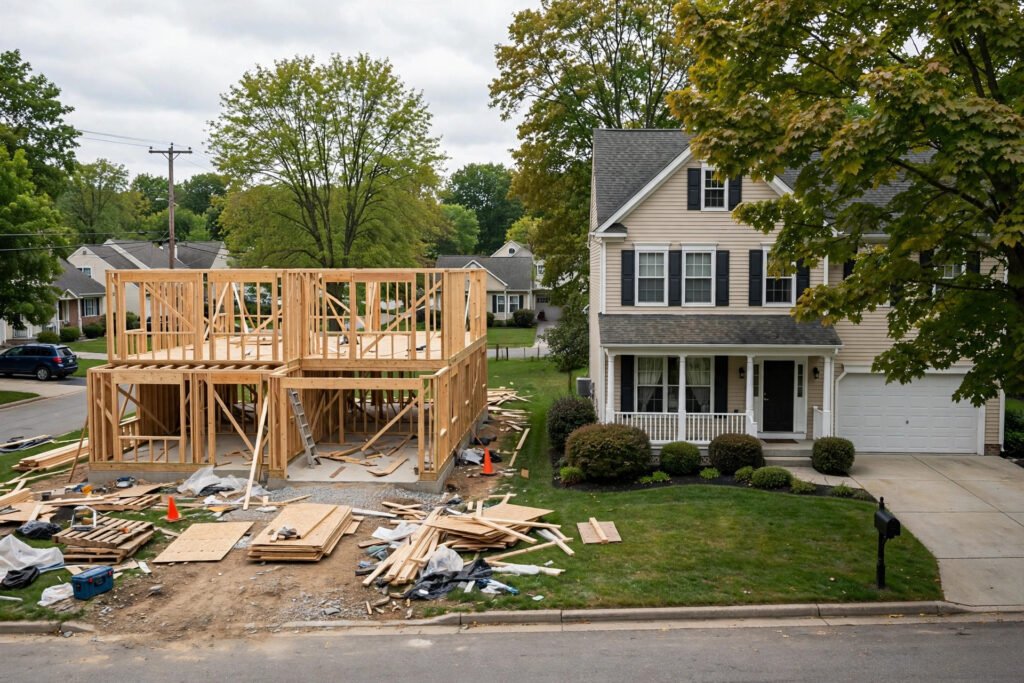
Is It Cheaper to Build or Buy a Home in the Midwest?
It is the question every Midwest homebuyer eventually asks, usually while staring at a listing for a dated ranch that needs everything: would it be cheaper to just build? The Midwest — with its affordable land, established builder networks, and no coastal insanity — is the region where building is most plausible. But “cheaper” turns out to be the wrong word. The real question is what you get for the money, and how much uncertainty you can stomach.
This guide compares building vs. buying a home in the Midwest on true all-in cost, timeline, risk, and the scenarios where each wins.
The Cost Comparison: Real Numbers
Buying existing: the Midwest median home price sits well below the national median — think roughly $250,000–$350,000 in most metro markets (higher in Chicago, Minneapolis, and Ann Arbor; lower in Cleveland, Detroit, Indianapolis, and smaller cities). That price includes land, structure, and existing infrastructure. Closing costs add 2–5%, and most buyers budget $10,000–$30,000 for immediate updates.
Building new: construction costs in the Midwest typically run $150–$250 per square foot for a standard custom or semi-custom build — so a 2,000 sq ft home costs $300,000–$500,000 in construction alone, before land. Land adds $30,000–$150,000+ depending on location (rural acreage is cheap; desirable suburban lots are not). Add site work (well/septic if rural: $15,000–$40,000), permits and fees ($5,000–$20,000), and the upgrades you will inevitably choose, and the all-in cost of building usually lands 15–40% above buying a comparable existing home.
The honest summary: building is rarely cheaper. Existing homes are discounted for their age, wear, and someone else’s choices; new construction charges full price for everything. The National Association of Home Builders publishes regional construction cost data that confirms the gap year after year.
When Building Wins Anyway
Cost is not everything. Building wins when: you have specific needs — multigenerational layouts, accessibility requirements, a home office wing, or energy standards (net-zero, passive house) that existing stock cannot provide. You own or can buy cheap land — a family lot or affordable rural acreage changes the math dramatically. The local existing stock is poor — in some markets, everything available needs $100,000+ of work, narrowing the gap. You value the warranty and efficiency — new builds come with builder warranties and modern insulation, HVAC, and windows that cut utility bills for decades.
Building also wins emotionally for people who have been burned by hidden problems in older homes — the peace of mind of knowing every pipe and wire has a price, even if that price is higher. Rural builds deserve special mention: on affordable acreage outside zoning-heavy suburbs, the land-cost advantage can be decisive. Just price the well, septic, long driveway, and utility runs honestly — rural site work routinely adds $30,000–$60,000 that suburban builders never face. And if you are weighing older homes, our guide to inspecting a fixer-upper before buying helps you price the alternative accurately.
When Buying Wins (Usually)
Buying an existing home wins on cost (almost always cheaper all-in), timeline (30–60 days to close vs. 8–14 months to build), location (established neighborhoods with mature trees, proven schools, and known commutes — new construction is usually on the fringe), and certainty (the price is the price; no lumber spikes or contractor delays).
It also wins on character and lot size — older Midwest neighborhoods often have bigger lots and architectural detail that new subdivisions cannot replicate at any price. And in buyer’s markets or balanced markets, negotiation can push existing-home prices well below asking, a discount unavailable in construction. The Census Bureau’s new residential construction data shows how build costs have tracked against existing prices over time.
The Hidden Costs of Building
First-time builders consistently underestimate: site work (grading, excavation, utility hookups — $20,000–$60,000 in surprises on difficult lots), upgrades (the model home has $80,000 in upgrades; your base price does not), carrying costs (construction loan interest, renting during the 8–14 month build, storage), landscaping and extras (builders deliver a house, not a yard — budget $10,000–$30,000 for grading, sod, driveway, and fencing), and delay costs (every month of delay is another month of rent plus loan interest).
The standard advice: budget a 10–15% contingency above the contract price and assume the timeline slips two months. Builders who promise otherwise are selling, not planning. Get everything in writing, understand the allowance structure (where cost overruns hide), and hire an independent inspector for phase inspections — your lender may require them anyway. Even single line items surprise first-time builders — windows alone can run into five figures on a new build.
Financing Differences
Buying uses a standard mortgage — straightforward, competitive rates, 30-year fixed available. Building uses a construction loan (short-term, higher rate, interest-only during construction, disbursed in draws as work completes), which then converts to a permanent mortgage. Construction loans require larger down payments (20–25% typical), detailed plans and budgets upfront, and a qualified builder — the bank underwrites the project, not just you.
Some buyers use a construction-to-permanent loan (one closing, converts automatically) to simplify. Either way, financing a build is more complex, more expensive during construction, and less forgiving of surprises. Get pre-qualified by a lender experienced in construction lending before you buy land — a standard mortgage pre-approval means nothing for a build. Interview builders like employees: ask for references from their last five clients (not handpicked favorites), visit a current job site unannounced, and verify licensing and insurance independently. Current rate environments matter enormously here; Freddie Mac’s published rate surveys help you model both scenarios.
The Bottom Line
In the Midwest, buying an existing home is cheaper, faster, and more certain than building in the vast majority of cases — usually by 15–40% all-in. Building wins when you have specific needs existing homes cannot meet, cheap land, or a strong preference for new everything with warranties. Run both scenarios with honest numbers (including the hidden costs above), add your contingency, and let the math decide. Just do not start a build believing it is the budget option — it almost never is. Get three builder quotes minimum — the spread will educate you fast. Visit a builder’s 5-year-old home: how their work ages tells you more than any model home tour.
Frequently Asked Questions
Is it cheaper to build or buy a house in the Midwest?
Buying is almost always cheaper — typically 15–40% less all-in than building comparable new construction. Building costs $150–$250+/sq ft plus land, site work, and upgrades, while existing Midwest homes benefit from depreciation discounts.
How long does it take to build a house in the Midwest?
Eight to fourteen months is typical for custom/semi-custom builds, plus 2–3 months for planning, permits, and financing. Weather can extend timelines — plan for winter delays.
What are the hidden costs of building a house?
Site work and utility hookups ($20,000–$60,000), upgrades beyond base specs, carrying costs during construction (rent + loan interest), landscaping ($10,000–$30,000), and delay overruns. Budget a 10–15% contingency.
Can I get a regular mortgage for new construction?
Not for a custom build — you need a construction loan (or construction-to-permanent loan), which has higher rates during construction, larger down payment requirements (20–25%), and disburses in draws. It converts to a standard mortgage on completion.