How to Get Better Grades in College Chemistry
General chemistry is the course that ends more pre-med dreams than any other. It is not that the material is impossibly hard — it is that college chemistry demands a completely different kind of studying than high school did. Memorizing definitions earned you an A in high school; in college chem, the exams test whether you can apply concepts to problems you have never seen. Students who adapt their approach thrive. Students who just “study harder” the old way drown.
This guide explains how to get better grades in college chemistry: the study methods that work for this specific subject, how to handle labs and exams, and the resources that make the difference.
Why College Chemistry Feels So Different
High school chemistry rewards memorization; college chemistry rewards problem-solving fluency. Exams present novel scenarios — “here is a reaction you have never seen; predict the products and explain why” — that no amount of flashcard drilling prepares you for. The pace is also brutal: a semester of general chemistry covers roughly what took a full year in high school, and each chapter builds on the last. Fall behind in week 3 (stoichiometry) and week 10 (equilibrium) becomes incomprehensible.
The mindset shift: stop asking “what do I need to memorize?” and start asking “what can I do with this concept?” Every study session should end with you solving problems, not re-reading notes. If you cannot work a problem from a blank page, you do not know the material — no matter how familiar it feels when you read it.
The Study System That Works for Chemistry
1. Pre-read before lecture (20 minutes)
Skim the upcoming chapter before class — not to learn it, but to know what is coming. Lectures transform from confusing to clarifying when your brain has a framework to hang new information on. Write down two questions the pre-read raised; getting them answered in lecture is active learning.
2. Work problems daily, not weekly
Chemistry is a skill, like piano — daily practice beats weekend marathons. Do 5–10 problems from each chapter section as you learn it, then mixed review problems weekly. The textbook’s end-of-chapter problems are gold; so are your professor’s old exams, which reveal exactly how they test. Khan Academy’s chemistry courses offer free worked examples for every major topic.
3. Build a concept map, not a formula sheet
For each chapter, draw how concepts connect: how does electronegativity relate to bond polarity, which relates to intermolecular forces, which explains boiling points? Students who see the connections solve novel problems; students with isolated facts cannot. And learn dimensional analysis (unit conversions) until it is automatic — it underlies half of general chemistry.
4. Use active recall and spaced repetition
Close the book and reproduce mechanisms, trends, and problem-solving steps from memory. Anki decks for chemistry (nomenclature, polyatomic ions, solubility rules) handle the memorization load efficiently, freeing study time for problem-solving. Review them in short daily bursts rather than marathon sessions — spaced repetition beats cramming for the memorization load. The American Chemical Society publishes study guides aligned to its standardized exams — worth their weight if your course uses ACS finals.
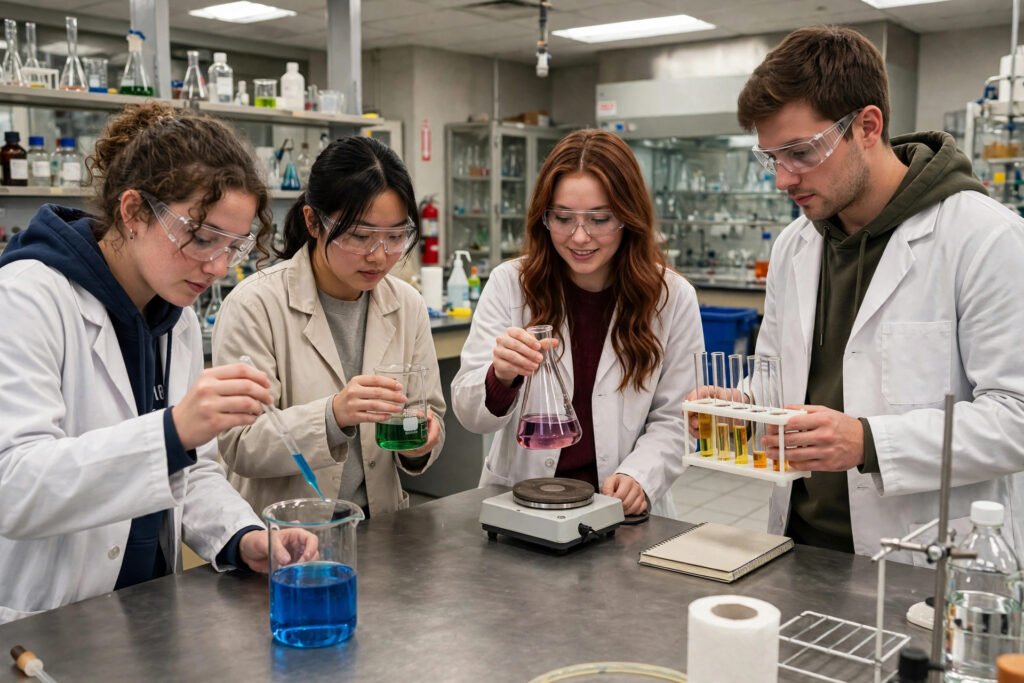
Mastering the Lab Component
Labs are 20–30% of your grade and the easiest points to lose through carelessness. Pre-lab prep is non-negotiable: read the procedure, understand the goal, and pre-write data tables before you walk in. Students who prep finish on time; students who do not spend the period confused. Lab reports are graded on specific rubrics — error analysis, significant figures, and clear conclusions. Learn what your TA rewards and deliver exactly that.
Treat significant figures and units as a religion from day one. Professors deduct for them relentlessly, and the habits compound. Keep a clean lab notebook; “I lost my data” is not a valid experimental result. And choose lab partners strategically — a reliable partner halves the stress of every experiment.
Exam Strategy: How Chem Tests Are Really Graded
Chemistry exams reward shown work. Partial credit is generous in most courses — a correct setup with an arithmetic error often earns 70–80% of the points, while a correct answer with no work earns little. Write every step: the balanced equation, the conversion factors, the units. Never leave a problem blank; write down everything relevant you know.
Time management matters: scan the whole exam first, do the problems you know cold, then attack the harder ones. Budget time per point — a 10-point problem deserves roughly twice the time of a 5-point one. And review the specific mistakes from every returned exam in a dedicated error log; chemistry mistakes repeat in patterns (sign errors in thermodynamics, anyone?), and the log breaks the cycle. For managing the broader academic workload, using AI study tools effectively can help you check your problem-solving approach — as long as you are learning, not copying.
When to Get Help (Early, Not Late)
The number-one predictor of chemistry success is seeking help before you are lost. Office hours are criminally underused — professors and TAs will walk you through exactly what confuses you, and they notice who shows up (which matters at grade boundaries). Tutoring centers on most campuses offer free chemistry tutoring; go weekly, not just before exams. Study groups of 3–4 committed students are powerful — explaining a concept to someone else is the ultimate test of understanding.
The rule: if you cannot solve the homework without the solutions manual, you need help now — not after the midterm. Chemistry is cumulative, and every week of confusion compounds. There is no shame in it; general chemistry is designed to be challenging, and the students getting As are mostly the ones who asked for help earliest. Make sure your tech setup supports long study sessions — a good budget laptop for college handles everything from molecular modeling to marathon problem sets.
The Bottom Line
Better grades in college chemistry come from a system, not heroics: pre-read before lectures, solve problems daily, map concepts instead of memorizing facts, take labs seriously, show all work on exams, and get help at the first sign of confusion. The students who struggle are usually studying hard with the wrong methods; switch the methods and the grades follow. Chemistry rewards the systematic — become systematic.
Frequently Asked Questions
Why is college chemistry so hard?
It combines fast pacing, cumulative content, and a shift from memorization to novel problem-solving. Students who adapt their study methods (daily problem practice, active recall) typically do well; those who rely on high-school memorization habits struggle.
How many hours should I study for chemistry each week?
Plan on 2–3 hours outside class per credit hour weekly — 8–12 hours for a 4-credit course. Daily short sessions beat weekend cramming because chemistry is a cumulative skill.
Are chemistry office hours actually helpful?
Enormously. Professors and TAs can diagnose your specific confusion in minutes, and regular attendees often get the benefit of the doubt at grade boundaries. It is the highest-ROI hour in your week.
What is the best way to study for a chemistry final?
Work old exams and mixed cumulative problem sets under timed conditions, review your error log from the semester, and re-derive (not re-read) the major concept connections. Focus on chapters that build on everything — equilibrium, thermodynamics, and electrochemistry integrate the whole course.