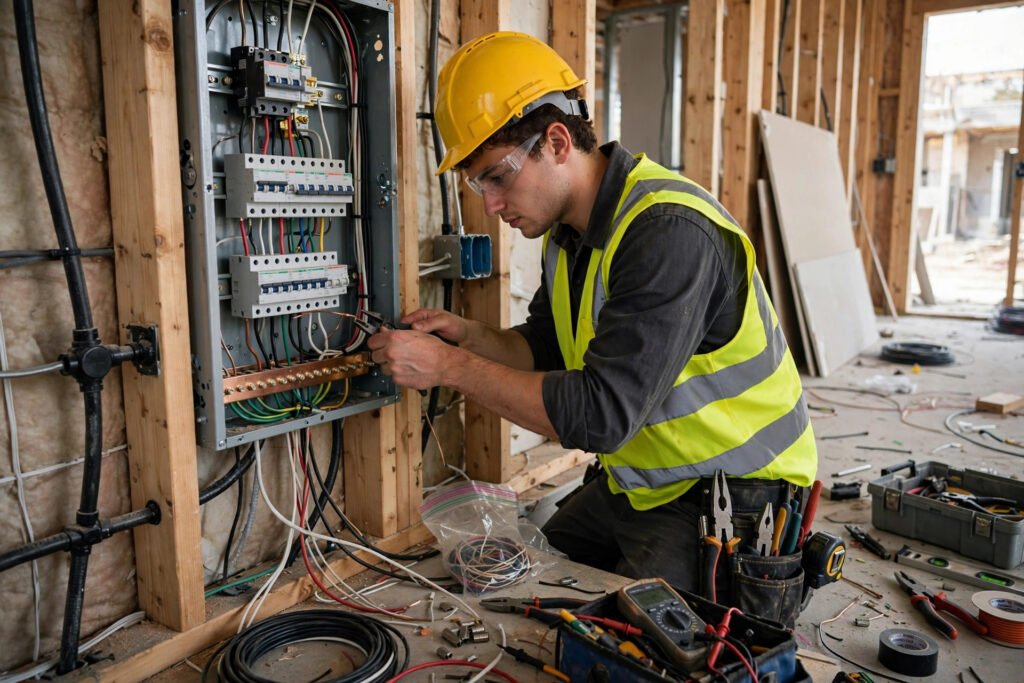
How to Become an Electrician Apprentice in Ohio (2026)
Electricians are among the best-paid skilled tradespeople in Ohio — journeymen in the state’s union market earn $70,000-$100,000+, and the path in does not require a four-year degree or student debt. Instead, it runs through an apprenticeship: 4-5 years of paid on-the-job training combined with classroom instruction, ending in a license and a career that cannot be outsourced or automated away.
This guide explains exactly how to become an electrician apprentice in Ohio in 2026 — the requirements, the two main paths (union vs. non-union), how to apply, what apprentices actually earn, and how to stand out in a competitive applicant pool. If you want a high-paying career without college debt, start here.
What an Electrical Apprenticeship Actually Involves
An Ohio electrical apprenticeship typically lasts 4-5 years (8,000-10,000 hours) of supervised work plus 600-900 hours of classroom instruction. You work full-time for a contractor — wiring new construction, troubleshooting, installing panels and lighting — while attending classes nights or weekends on electrical theory, code, and safety.
You earn while you learn. Apprentice wages start around 40-50% of journeyman scale (roughly $18-$25/hour in Ohio’s union market) and rise on a fixed schedule with each year completed. By year four, apprentices earn 80%+ of journeyman wages. Benefits — health insurance, pension contributions — often start immediately in union programs, which is a massive advantage over most entry-level jobs.
After completing the hours and passing Ohio’s journeyman examination (administered through the Ohio Construction Industry Licensing Board for commercial work, or local licensing for residential depending on municipality), you become a licensed journeyman electrician — and your earning power jumps to full scale.
The Two Paths: Union (JATC) vs. Non-Union (ABC/IEC)
Union path — IBEW/NECA JATC: Joint Apprenticeship and Training Committees run by the International Brotherhood of Electrical Workers and the National Electrical Contractors Association operate in every major Ohio city (Columbus, Cleveland, Cincinnati, Dayton, Toledo, Akron). JATC programs are free — no tuition — highly structured, and lead to the highest wages and best benefits. They are also the most competitive: applicants take an aptitude test (math and reading), interview, and rank on a list. The IBEW’s site links to local JATC applications.
Non-union path — ABC/IEC: Associated Builders and Contractors and the Independent Electrical Contractors association run merit-shop apprenticeships, often sponsored by specific employers. These are typically easier to enter — many contractors hire apprentices directly — and offer more geographic flexibility. Wages start lower than union scale but rise with skill, and top non-union electricians earn very well.
Which to choose? Apply to both. The union path offers better pay, benefits, and training depth; the non-union path offers faster entry and flexibility. Many successful electricians start non-union and organize into the IBEW later, or vice versa. Do not let path ideology delay your start — hours in the trade beat months of deliberation.
Requirements and How to Apply
Basic requirements across Ohio programs: 18+ years old, high school diploma or GED, valid driver’s license, reliable transportation, and passing a drug test. The JATC aptitude test covers algebra and reading comprehension — brush up on basic algebra (solving for x, fractions, decimals) before testing; it eliminates more applicants than any other step.
Application steps: 1) Apply to your local JATC (applications open in specific windows — check now, some only open annually) and to ABC/IEC chapters simultaneously. 2) Take the aptitude test and interview for JATC. 3) While waiting, apply directly to electrical contractors as a helper/material handler — this gets you in the industry, builds relationships, and many helpers get sponsored into apprenticeships. 4) Consider pre-apprenticeship programs at Ohio community colleges (Columbus State, Cuyahoga Community College) which strengthen applications.
Stand out by: having construction or mechanical experience of any kind, holding OSHA-10 certification (a $50 online course that signals seriousness), showing up with tools and a work ethic, and following up persistently. Apprenticeship coordinators remember the applicants who call back. The federal Apprenticeship.gov portal lists registered programs by zip code.
Pay, Career Progression, and the Long Game
Ohio journeyman electricians earn roughly $28-$45/hour depending on market and specialization — $60,000-$95,000 annually, with overtime pushing higher. Specializations pay premiums: industrial electricians, linemen (a separate but related path earning $100,000+), fire alarm/security systems, and solar installation. BLS data for electricians shows Ohio wages tracking above national medians in metro markets, with 6%+ projected job growth.
The long game is where it gets lucrative. Master electricians can pull permits and run their own shops — Ohio electrical contractors billing $100-$150/hour with a crew routinely clear $150,000-$300,000+. Others move into estimating, project management, inspection, or teaching. The trade also travels: licensed electricians find work in every state, and industrial shutdown/turnaround work pays extraordinary short-term rates.
Compared to a four-year degree path, the math is compelling: zero tuition (union) versus $40,000-$100,000 in student debt, earning from day one versus four years of negative cash flow, and journeyman wages by age 23-24 that rival many bachelor’s-degree outcomes. For the mechanically inclined, it is one of the best deals in the American labor market. Career changers should also weigh which jobs are safest from AI automation — the trades rank near the top — and note that DIY electrical work has real limits that keep professionals in demand.
A practical tip for applicants: start the process 3-6 months before you want to be working. JATC applications open in limited windows, aptitude testing and interviews add weeks, and ranked lists move slowly. Use the waiting time productively — get OSHA-10 certified, take a community college electrical basics course, and work as a material handler for a local contractor. Every month of industry exposure strengthens your application and your paycheck, so the waiting period becomes an advantage rather than dead time.
Conclusion
Becoming an electrician apprentice in Ohio means: meeting the basic requirements, applying to both JATC (union) and ABC/IEC (non-union) programs, acing the aptitude test with algebra prep, and getting hired as a helper while you wait. Four to five years of paid training later, you hold a license, zero debt, and a $70,000-$100,000+ career with a clear path to six figures as a master or contractor. The application window may be open right now — go check.
Frequently Asked Questions
How long does an electrician apprenticeship take in Ohio?
Typically 4-5 years (8,000-10,000 work hours plus 600-900 classroom hours). You work full-time and earn wages throughout, with pay rising each year.
How much do electrician apprentices make in Ohio?
Starting pay is roughly $18-$25/hour (40-50% of journeyman scale in union programs), rising to 80%+ of journeyman wages by the final year. Union programs include health and pension benefits from early on.
Do I need college to become an electrician in Ohio?
No. You need a high school diploma or GED, to be 18+, and to complete an apprenticeship. Strong basic algebra helps enormously with the aptitude test.
Is the IBEW apprenticeship hard to get into?
It is competitive — applicants are ranked by aptitude test scores and interviews. Improve your odds with algebra prep, OSHA-10 certification, any construction experience, and applying to multiple programs including non-union options.
What is the difference between a journeyman and master electrician in Ohio?
A journeyman is licensed to perform electrical work; a master has additional experience and can pull permits, supervise journeymen, and operate a contracting business. Master status is the gateway to owning your own shop.