How to Learn to Swim as an Adult in 30 Days
Learning to swim as an adult feels embarrassing — until you realize how common it is. Roughly a third of American adults can’t swim well enough to save themselves, and adult swim classes are full of people exactly like you: capable adults who never learned, or learned badly as kids and forgot. The good news: 30 days of focused practice is enough to take most adults from fearful to functional — swimming laps, treading water, and feeling safe. Here’s your 30-day plan.
Days 1–7: Water Comfort and Breathing
Week one isn’t about swimming — it’s about comfort. Most adult non-swimmers’ real barrier is panic, not technique: the body’s alarm response to water on the face and the instinct to thrash. Start in the shallow end where you can always stand: practice putting your face in the water and exhaling slowly through your nose and mouth (blowing bubbles — the single most important beginner skill), floating on your front and back with light support, and standing up smoothly from a float. These sound trivial; they’re the foundation everything builds on, and rushing them is the #1 beginner mistake.
Key skill: rhythmic breathing. Inhale above water, exhale underwater — never hold your breath while swimming. Practice bobs: submerge, exhale fully, surface, inhale — ten reps. If water in your nose bothers you, a nose clip ($5) removes the distraction while you learn. The CDC’s drowning prevention resources underscore why these fundamentals matter: comfort in water is itself a survival skill.
The Mental Game: Overcoming Fear of Water
Let’s address the real obstacle, because for most adult non-swimmers it isn’t physical — it’s fear, embarrassment, or a bad childhood memory. Aquaphobia in adults is common and treatable, and the 30-day plan works because it starts with comfort rather than technique. Forcing yourself into the deep end on day one reinforces panic; gradual exposure dissolves it.
Practical fear-management: always practice where you can stand, keep sessions short enough to end on a success (leave the pool feeling good, not exhausted), and use tools shamelessly — nose clips, goggles, kickboards, pool noodles are training equipment, not crutches. Tell your instructor about your fear upfront; adult-learn instructors are specifically trained for this and will pace accordingly. Many adults find that week two is the turning point — once your body learns that exhaling underwater is safe, the panic response quiets dramatically.
If fear is severe (racing heart at the pool’s edge, inability to enter water), consider 2–3 sessions with a therapist specializing in phobias alongside your swim lessons — systematic desensitization works quickly for water fear. There’s no shame in it; the shame would be letting fear keep you from a life skill.
Days 8–16: The Basics of Propulsion
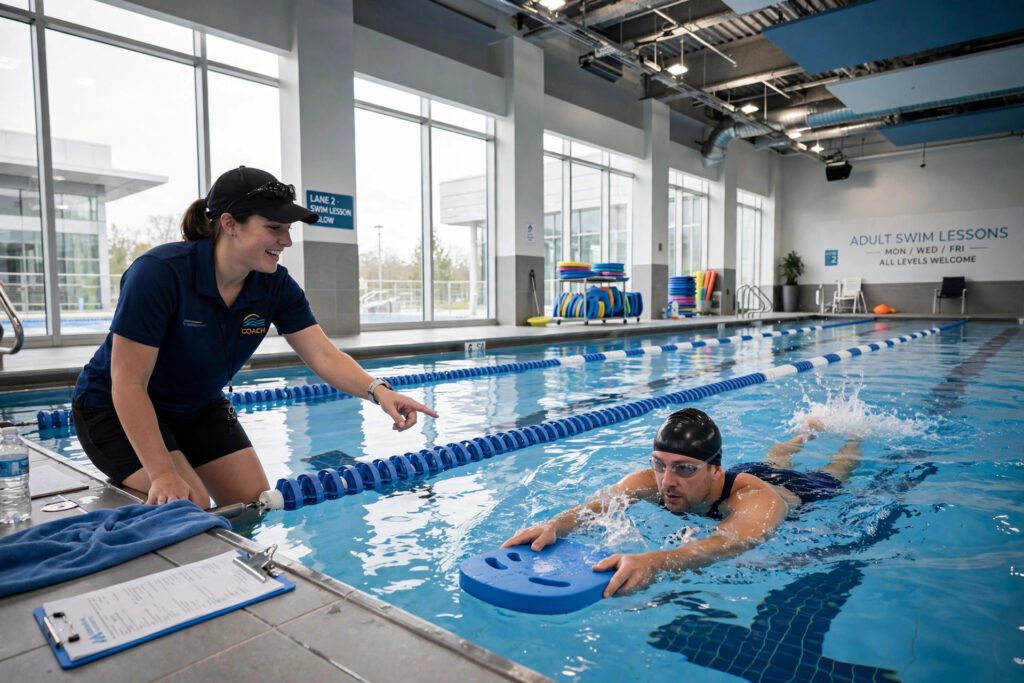
Week two introduces movement. Start with kicking: hold the pool wall or a kickboard, keep legs mostly straight with a gentle flutter from the hips (not bicycling knees), toes pointed. Then add arm strokes: freestyle’s alternating overarm pull, keeping one ear in the water as you rotate to breathe. The coordination feels impossible at first — that’s normal; every swimmer went through it.
Drill, don’t just swim: 25-yard repeats of kick-only (with a kickboard), then pull-only (with a pull buoy between your thighs so your legs float), then full stroke. Short, focused repetitions build technique faster than exhausted flailing — stop each repeat while your form is still good, rest 15–30 seconds, and go again. Ten quality 25s beat one sloppy 250 every time. Consider 2–3 lessons from a certified instructor during this phase — an hour of professional eyes corrects what weeks of solo practice can’t. The American Red Cross offers adult swim lessons nationwide with instructors trained specifically for adult learners.
Days 17–24: Building Endurance and Treading Water
Week three is about putting it together: swim continuous 25s, then 50s, focusing on relaxed, sustainable pace — not speed. Most beginners swim too hard; efficient swimming feels almost lazy. Count strokes per length and try to reduce the number — fewer, longer strokes signal improving technique.
Learn treading water (the survival skill): eggbeater or flutter kick with sculling hands, keeping your head above water with minimal effort — think efficiency, not splashing. Practice in the deep end with a lifeguard present, starting with 30-second intervals and building up. Also learn to float on your back indefinitely — it’s your rest position and emergency fallback. Fuel your sessions properly: pre-workout nutrition guidance applies to pool sessions too. And ramp up gradually — beginner injury-prevention principles (rest days, gradual progression) work for swimming as well.
Days 25–30: Consolidation and Water Safety
The final stretch: swim 200+ yards continuously (any stroke mix), tread water for 2+ minutes, and practice the survival sequence — swim 25 yards, tread 1 minute, float on back 1 minute. These are the core competencies of a functional swimmer. Test yourself in a supervised setting, not alone.
Learn water safety alongside technique: never swim alone, understand rip currents if you’ll swim outdoors, and know your limits — most drownings involve overestimation of ability. The goal of 30 days isn’t Olympic form; it’s competence and safety. You’ll refine technique for years; the transformation from non-swimmer to swimmer is what these 30 days deliver.
Beyond Day 30: Keeping It Going
Don’t stop at 30 days — that’s when swimming gets genuinely enjoyable, when technique clicks and the water starts feeling like yours. Join a masters swim group (welcoming to all levels despite the intimidating name), set a distance goal (a continuous 500 yards, then a mile), or try open-water swimming with proper safety and a buddy. Swimming is among the best lifelong exercises: zero-impact, full-body, and sustainable into old age. The hardest part was starting; everything after is just swimming.
Conclusion
Learning to swim as an adult in 30 days works: week one builds water comfort and breathing, week two adds kicking and strokes through focused drills, week three builds endurance and treading water, and week four consolidates genuine survival skills. Add 2–3 professional lessons, practice 3–4 times weekly, respect water safety throughout, and be patient with the fear — it fades as competence grows. Thirty days from now, you’ll be a swimmer — and you’ll wonder why you waited so long.
Frequently Asked Questions
Can adults really learn to swim in 30 days?
Yes — with 3–4 focused sessions per week, most adults go from non-swimmer to swimming laps and treading water in 30 days. It’s about consistent practice, not talent.
Is it embarrassing to take swim lessons as an adult?
Not at all — adult classes are full of beginners, and instructors specialize in adult learners. Everyone there shares your starting point; the embarrassment fades in the first session.
How often should I practice?
3–4 times per week, 30–45 minutes per session. Frequency matters more than duration — regular short sessions build comfort faster than occasional long ones.
Do I need goggles?
Yes — they’re essential, not optional. Being able to see underwater dramatically accelerates learning and comfort. A $15–$25 pair works perfectly.
What if I’m afraid of deep water?
Extremely common. Progress gradually: master skills in shallow water first, then practice them at increasing depths with a lifeguard or instructor present. Fear fades as competence grows.