How to Save $10,000 in One Year on a Tight Budget: Blueprint
Saving $10,000 in one year sounds like a fantasy when money is already tight — that is $833 a month, more than many people’s entire discretionary budget. But thousands of ordinary earners do it every year, not through deprivation marathons but through systems: automated transfers, targeted spending cuts, and strategic income boosts that compound over twelve months. The math is non-negotiable ($10,000 ÷ 12 = $833/month, or $385 biweekly, or $192 weekly), but the method is flexible. This is a month-by-month blueprint for saving ten grand on a tight budget — where the money comes from, how to automate it so willpower is irrelevant, and how to stay the course when motivation fades in month four.
The Math: Breaking $10,000 Into Manageable Pieces
$10,000/year = $833/month = $385/paycheck (biweekly) = $27.40/day. The daily figure reframes everything: this is not about finding $10,000; it is about finding $27 a day through some combination of spending less and earning more. Most successful savers split it roughly: $400–$500/month from spending cuts and $300–$400/month from extra income. Neither half alone feels crushing; together they hit the target. Write your personal split down now — “I’ll cut $450 and earn $383 extra monthly” — because vague intentions save nothing. The CFPB’s savings resources confirm what behavioral research shows: specific, written savings targets dramatically outperform vague goals.
Phase 1: The Quick Wins (Month 1 — Target: $800+)
Month one is about immediate cash flow surgery:
- Audit subscriptions ruthlessly: streaming services, apps, memberships, subscription boxes — the average American bleeds $200+/month on these. Cancel everything you have not used in 30 days. Potential savings: $50–$150/month.
- Renegotiate bills: call your internet, phone, and insurance providers and ask for better rates or competitor-match. One afternoon of calls routinely saves $50–$100/month.
- Kill food waste and dining splurges: meal plan for two weeks, cook in bulk, and cap dining out at a fixed budget. Food is the most flexible big expense — our guide to saving on groceries without couponing details the tactics. Potential savings: $150–$300/month.
- Sell the obvious stuff: that bike, those electronics, the clothes with tags — list everything this weekend. Month-one target: $200–$500 in sales.
- Open a separate high-yield savings account and automate the first transfer today. Money that never touches checking does not get spent.
Phase 2: The Structural Cuts (Months 2–4 — Target: $450+/month ongoing)
Quick wins fade; structural changes compound:
- Housing: the biggest lever. A roommate, a move to a cheaper unit at lease renewal, or renting out a spare room can free $300–$800/month — single-handedly covering half the goal.
- Transportation: refinance a high-rate car loan, shop insurance annually, carpool, or — the nuclear option — sell a car and go down to one. Transportation is most families’ second-largest expense.
- The 48-hour rule: all non-essential purchases wait 48 hours. Roughly 70% never get bought. This single habit saves most practitioners $100–$200/month.
- Utility discipline: programmable thermostat, LED bulbs, shorter showers, unplugging energy vampires — $30–$60/month in most households.
Phase 3: The Income Boost (Months 2–12 — Target: $350+/month)
Cutting has limits; earning does not. Realistic options for tight schedules:
- One focused side gig: freelancing, delivery driving, tutoring, or reselling — 5–8 hours weekly at $20–$30/hour yields $400–$900/month. Our no-money-down side hustle guide lists options by time commitment.
- Overtime and extra shifts: the simplest boost if available — no new skills, no startup time.
- Monetize what you own: rent out a parking spot, storage space, tools, or camera gear. Assets earning while you sleep.
- Reselling: thrift-store flipping and online arbitrage can generate $200–$500/month part-time — our breakdown of reselling income potential sets realistic expectations.
Direct all side income to savings by default — it is “extra” money only if you decide it is; make the decision once, automatically.
The Automation System (The Whole Game)
Willpower fails; systems persist. Set up:
- Payday auto-transfer: $385 moves to savings the morning of every paycheck — before bills, before spending, before thought.
- Round-up apps: spare-change investing adds $30–$60/month invisibly.
- Windfall rule: tax refunds, bonuses, cash gifts — 75% to savings automatically, 25% guilt-free fun. The fun portion prevents rebellion.
- Monthly 10-minute review: check progress against the $833/month pace. Behind? Identify one adjustment. Ahead? Do not ease off — bank the buffer for hard months.
Staying the Course: Months 4–9 (The Danger Zone)
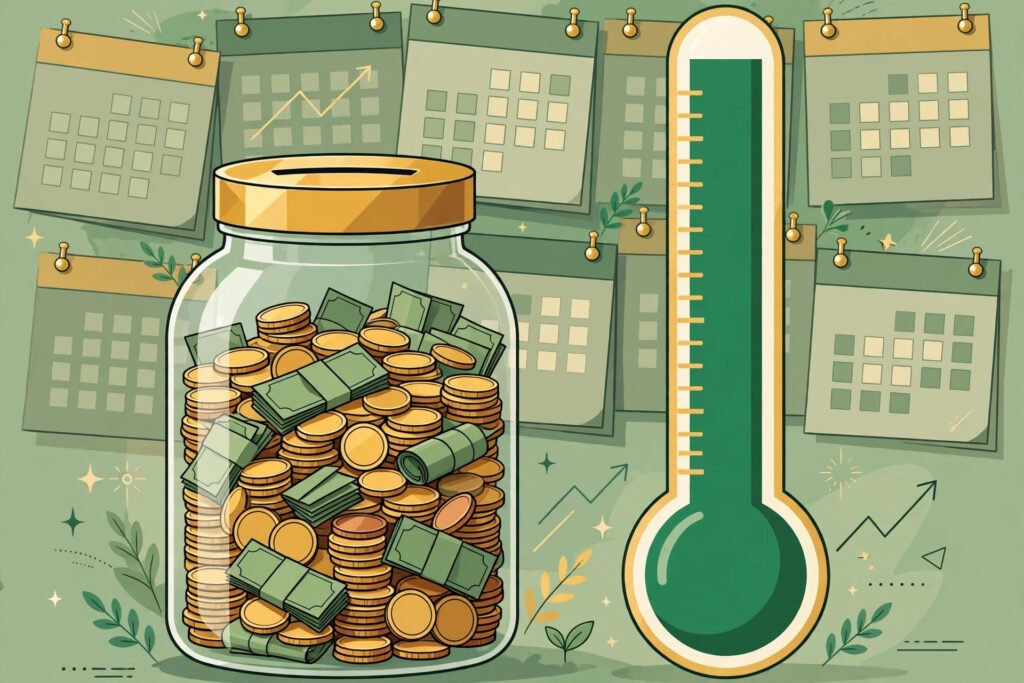
Motivation peaks in January and craters by April — plan for it. Tactics that work: track progress visually (a thermometer chart on the fridge; watching it fill is absurdly motivating); find an accountability partner with a similar goal; pre-plan for known expensive months (holidays, back-to-school) by banking extra in cheap months; and permit planned “cheat” spending within the 25%-of-windfalls rule so deprivation does not trigger binges. If you fall behind, do not restart — recalibrate: divide the remaining amount by remaining months and adjust. A revised plan you follow beats a perfect plan you abandoned.
Where to Keep It
A high-yield savings account earning 4–5% — FDIC-insured, separate from checking, slightly inconvenient to raid. On $10,000, the yield adds ~$200+ over the year versus a regular savings account — free money for the same discipline. Do not invest this money in stocks or crypto: twelve months is too short for market risk, and a 20% drawdown in month eleven would be devastating. This is savings, not investing — different job, different vehicle. The FDIC’s savings resources explain why insured accounts are the right home for short-term goals.
Conclusion
Saving $10,000 in a year on a tight budget is a systems problem, not a willpower problem: $833/month split between targeted spending cuts ($400–$500) and extra income ($300–$400), automated on payday, tracked monthly, and protected in a high-yield account. The quick wins fund month one; structural cuts and side income carry months two through twelve; the windfall rule and visual tracking carry you through the motivation dip. Start this week with the subscription audit and the automated transfer — by this time next year, the “impossible” $10,000 will be sitting in your account, and you will know exactly how to do it again.
Frequently Asked Questions
Is saving $10,000 in a year realistic on a low income?
It depends on the gap between income and essential expenses — but the combination of aggressive cuts plus side income makes it achievable for many households earning $40,000+. The key is treating it as a system, not a sacrifice.
What’s the fastest way to save $10,000?
Front-load with asset sales and windfalls (month one can realistically produce $1,000+), then sustain with automated monthly transfers split between cuts and extra income. There are no shortcuts beyond earning more or spending less.
Should I save $10,000 or pay off debt first?
High-interest debt (8%+) first — its guaranteed return beats savings yields. But keep a $1,000 starter emergency fund while attacking debt, so surprises do not create new borrowing.
Where should I keep my $10,000 savings goal?
A high-yield savings account: FDIC-insured, 4–5% APY, separate from daily spending money. Not stocks or crypto — twelve months is too short for market volatility.
What if I fall behind on my savings goal?
Recalibrate, do not restart: divide the remaining amount by remaining months for a new monthly target. Temporary income boosts (overtime, a focused selling weekend) can close most gaps.