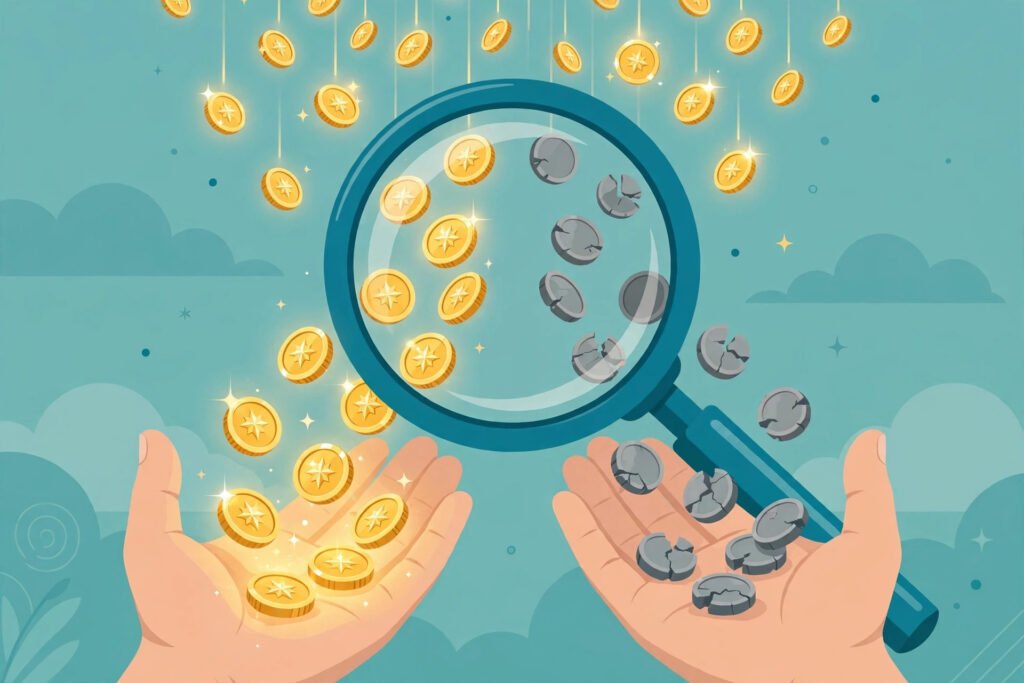
Find Legitimate Crypto Airdrops Without Getting Scammed
Free crypto for using a product early — that is the promise of airdrops, and it is real: protocols have distributed billions of dollars in tokens to early users, with some individual recipients collecting five or six figures from a single drop. Naturally, where free money flows, scammers follow — fake airdrop sites are among crypto’s most effective theft machines, draining wallets the moment victims “claim” their tokens. Telling legitimate distributions from sophisticated traps is a learnable skill. This guide shows how to find real airdrops, qualify for them safely, claim without getting robbed, and handle the tax implications of free tokens.
What Legitimate Airdrops Look Like
Real airdrops share a pattern: they reward past usage of a protocol, announced retroactively. Uniswap’s 2020 airdrop gave 400 UNI (worth thousands) to anyone who had used the exchange before a cutoff date — no signup, no forms, no advance notice. Legitimate drops come from established protocols with real products, announced through official channels (the project’s verified X account, official Discord, governance forum), with eligibility based on on-chain history you can verify yourself on a block explorer. The claim process happens on the project’s official domain — bookmarked by you, never clicked from a DM. If you have to “register” for an airdrop before using anything, provide personal information, or send any crypto to “unlock” your allocation, it is not legitimate.
Where to Find Real Opportunities
- Use promising protocols genuinely: the highest-probability strategy is simply being an early, real user of quality new protocols — bridge assets, try testnets, provide liquidity in small amounts. Retroactive rewards favor authentic usage over farming.
- Airdrop aggregators: sites like Airdrops.io and CoinMarketCap’s airdrop section list opportunities, but treat them as starting points for research, not endorsements — aggregators list paid promotions alongside real drops.
- Protocol governance forums and official Discords: legitimate projects discuss token plans openly; rumors of snapshots circulate here first.
- On-chain data: tools showing which wallets interact with new protocols help you spot rising usage before announcements.
The meta-strategy: position yourself as a genuine early user of things that might succeed, rather than chasing rumored drops. The former gets rewarded; the latter gets scammed. Apply the same verification discipline you would when checking whether online claims are fake — cross-reference everything against official sources.
Red Flags: The Scam Playbook
Fake airdrops are industrialized. Watch for:
- DMs and unsolicited messages announcing you have won tokens — legitimate projects never distribute via cold DMs.
- Lookalike domains (uniswap-claim.com, airdrop-uniswap.org) — always navigate to official sites via your own bookmarks.
- “Connect wallet and sign to claim” on unknown sites — the signature often grants token approvals that drain your wallet. This is the #1 theft mechanism.
- Requests for seed phrases — never, for any reason, on any site, for any “verification.”
- Upfront payments to “unlock” or “activate” your airdrop — real drops never charge.
- Urgency and countdown timers — manufactured pressure to stop you thinking. Real claim windows last weeks or months.
- Tokens appearing in your wallet unsolicited with instructions to visit a site — the tokens are bait; the site is the trap. Hide and ignore them.
If an offer triggers even one of these, walk away. The CFPB’s crypto scam alerts document how these schemes evolve — worth a read before your first claim.
Safe Claiming Practices
- Use a dedicated claiming wallet — never claim from your main vault. Move the airdropped tokens to secure storage afterward.
- Verify the URL independently: check the project’s official X/Discord for the exact claim link; compare character by character.
- Read every signature request. A legitimate claim asks you to sign a simple message or a standard claim transaction — not unlimited token approvals. When in doubt, simulate the transaction with a wallet security extension.
- Revoke approvals after claiming via revoke.cash or your wallet’s approval manager.
- Be patient: legitimate claim windows run for months. There is never a reason to rush.
The Farming Question: Is Chasing Airdrops Worth It?
Honest math: professional airdrop farmers run dozens of wallets through systematic protocol usage, treating it as a part-time job with real (if inconsistent) returns — the best quarters have paid like a solid side income, with top farmers reporting five-figure hauls from a single protocol’s distribution. For casual users, the expected value is lower but the cost is just genuine curiosity: try new protocols with small amounts, learn how DeFi works, and occasionally get rewarded for being early. What is not worth it: paying for “guaranteed airdrop” courses, buying followers or fake volume, bridging large sums between chains purely for snapshot speculation, or spending money you cannot afford on gas fees chasing rumored eligibility criteria. Treat airdrop eligibility as a side effect of learning crypto, not as an income strategy — and never let the pursuit expose your main holdings to experimental contracts. Before trusting any crypto-adjacent website with your wallet, run the same checks as verifying an online store’s legitimacy.
A simple personal airdrop system
If you want to be deliberate about it, keep it lightweight: maintain one dedicated “explorer” wallet funded with a fixed monthly budget ($50–$100), use two or three promising new protocols each month with real transactions, and keep a simple log of what you tried and when. Review quarterly, claim anything you earned, and never exceed the budget. This turns random chasing into a bounded experiment — you learn the ecosystem, cap the downside, and stay positioned for the occasional rewarding surprise.
Taxes on Airdrops: Yes, Really
The IRS treats airdropped tokens as ordinary income at their fair market value when you receive them (when you have control over them). A $2,000 airdrop is $2,000 of taxable income — even if the token later crashes to $50. This creates the cruel scenario of owing tax on value that evaporated; consider selling enough immediately to cover the tax bill. Record the receipt date and value for every drop. Later sales trigger additional capital gains or losses against that income basis. The IRS virtual currency FAQ addresses airdrop taxation directly.
Conclusion
Legitimate crypto airdrops reward genuine early users of real protocols — find them by using promising products, verifying announcements through official channels, and claiming carefully from a dedicated wallet with every URL double-checked. Scams impersonate this process with DMs, lookalike sites, malicious signatures, and manufactured urgency; any one of those signals means walk away. Treat airdrop hunting as paid education rather than income, keep immaculate tax records, and never risk your main holdings for free tokens. The free money is real — but only for those disciplined enough to claim it safely.
Frequently Asked Questions
Are crypto airdrops real or scams?
Both exist. Real airdrops from established protocols have distributed billions to users; fake airdrops are among the most common crypto scams. The difference is verifiable: real ones reward past usage and are announced on official channels.
Do I need to pay to receive an airdrop?
No. Legitimate airdrops never require payment, deposits, or “activation fees.” Any request for money to unlock tokens is a scam by definition.
How are airdrops taxed in the US?
As ordinary income at fair market value when received. If you later sell the tokens, additional capital gains or losses apply against that basis.
Can airdrops drain my wallet?
Claiming on a malicious site can — fake claim pages request token approvals or signatures that let attackers empty your wallet. Always claim from a dedicated wallet with minimal funds, and verify URLs independently.
What’s the best wallet for claiming airdrops?
A separate “burner” wallet used only for claiming and experimenting — never your main holdings wallet. Move claimed tokens to secure storage immediately after.